Disclaimer: This article is for informational purposes only and does not constitute financial advice. BitPinas has no commercial relationship with any mentioned entity unless otherwise stated.
📬 Get the biggest crypto stories in the Philippines and Southeast Asia every week — subscribe to the BitPinas Newsletter.
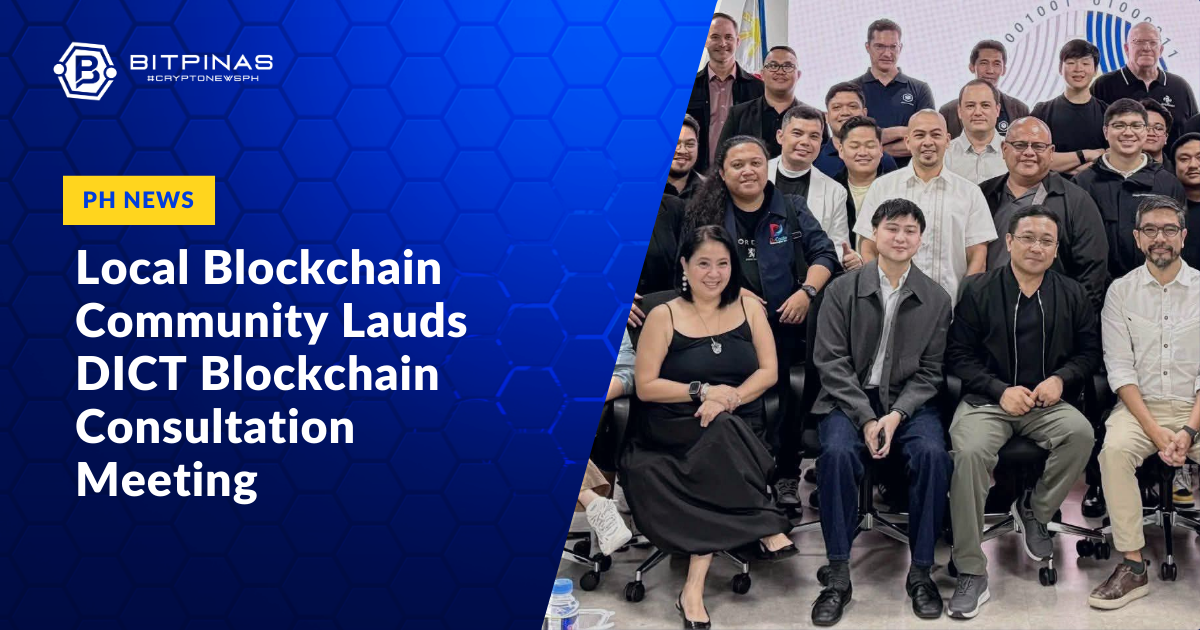
Following the Department of Information and Communications Technology’s (DICT) recent call for an industry consultation meeting regarding the Philippine government’s adoption of blockchain technology, various voices from the local web3 and tech sectors have stepped forward to pledge support and raise critical standards.
The meeting, led by DICT Undersecretary for E-Government David Almirol, aimed to gather insights from the private sector on how to effectively build and implement a sovereign digital backbone.
DICT’s Consultation Meeting a Must, Says Industry Voices
For Anne Cuisia, the founder of Manny Pay technology provider Traxion Tech and trustee at Qadena Foundation, a government-owned blockchain has to be open in process and rigorous in architecture, and thus demands open technical review, tech-neutral standards, and shared validation across the government, private sector, civil society, and academe.
(Disclosure: Ann Cuisia is a regular contributor at BitPinas)
She argued that an infrastructure, specifically at a national level, should be challenged early, debated publicly, and refined by many minds, much like the strongest systems. This is to ensure that the government-owned blockchain will be designed for real user-level transactions, budget flows, compliance triggers, and audit trails, and will not just place copy-pasted documents on the chain, Cuisia added, which she coined as a “glorified notary.”
“If we are serious about a national blockchain, it cannot be built around one provider, one press release cycle, or one series of MOA signings.
A sovereign digital backbone should be the product of collective design. Engineers who understand enterprise systems. Architects who understand distributed ledgers. Practitioners who know government workflows at the transaction level.”
Anne Cuisia, Founder, Traxion Tech
A similar point was raised by Blockchain Investigator Ferdie James Nervida, who was a DICT Cybersecurity and Blockchain Consultant in 2025. He emphasized that constructive dialogue between the government and industry will help ensure strong outcomes.
“Undersecretary David Almirol shared that DICT intends to build around eGOVchain as a foundational platform. Architectural clarity strengthens trust.”
Ferdie James Nervida, Blockchain Investigator
Industry Leaders Pledge Support
(Disclosure: Bayanichain’s Paul Soliman is a regular contributor at BitPinas)
Meanwhile, Rod Albores, the co-founder of Davao City-born tech organization RER DAO, committed that his team is ready to collaborate with DICT’s “thrust to align the Philippines’ first national blockchain initiative from vision to execution.”
He also highlighted that the goal of having a national blockchain is “not a solo effort,” saying that the consultation forum has shaped the foundation of the Philippine blockchain future.
“The hope is simple: alignment across agencies and sectors. Not for optics. Not for compliance. But for real, concrete, and actionable systems that citizens can trust.”
Rod Albores, Co-Founder, RER DAO
Consequently, contributing to the national blockchain efforts in the country is not just a milestone but also a responsibility, as shared by DvCode CEO Eliezer Rabadon.
He also pledged to represent the sentiment of developers, which are grounded, technical, and solution-oriented.
“What started as grassroots discussions within the blockchain and Web3 community has now evolved into contributing to the broader dialogue on a national blockchain initiative.
If blockchain is going to be part of national infrastructure, it must be implemented correctly—practical use cases, clear governance, security-first architecture, and no unnecessary over-engineering. It should solve real problems.”
Eliezer Rabadon, Chief Executive Officer, DvCode
The Context: What the Meeting is All About
Under the Republic Act No. 12254, known as the E-Governance Act, digital transformation and security standards across government agencies are mandated. However, the kind of technology to be used is undefined.
Earlier this year, in a press conference in Malacanang Palace, DICT Sec. Henry Aguda confirmed that the Philippines is becoming the first country to implement a fully on-chain national budget, with the initiative to be started with the 2026 General Appropriations Act, calling it as a “leap for transparency.”
While the project aims to cover the entire government bureaucracy, the initial development was executed at “no cost to the government” through a private sector grant.
Aguda also revealed that the initiative is partnered with local blockchain technology provider BayaniChain to build the initial infrastructure, which will soon transition from a public blockchain to a “Consortium Blockchain” owned by the government.
In a response to a BitPinas inquiry, Almirol clarified that the DICT is making sure that it is implementing a “real blockchain,” not just a concept nor a reinvented idea.
The consultation meeting was attended by numerous representatives from the wider crypto and blockchain industry. including Blockchain Council of the Philippines President Luis Buenaventura, BayaniChain’s Gelo Wong and Paul Soliman, Bicol-based Sparkpoint CEO Ismael Jerusalem, and Base Philippines Country Manager Eli Becislao.

This article is published on BitPinas: Local Blockchain Community Lauds DICT Blockchain Consultation Meeting
What else is happening in Crypto Philippines and beyond?