
This editorial is from this week’s edition of the newsletter Week in Review, sent to subscribers on Friday. Subscribe to the newsletter to get this weekly editorial the second it’s finished. The newsletter also includes the biggest stories of the week with a comment on each story.
Bitcoin capitulated below its 200-week moving average with a big red candle, trading at $62,495 as of Friday morning. Ethereum saw similar blood, and the altcoin sector in general collapsed further, even the outliers that were shining in previous weeks.
Meanwhile, the stock market continued its parabolic ascent, with the S&P 500, Nasdaq, and Dow Jones all hitting new record levels yet again.
Traditional markets look unstoppable. The S&P 500 is on track for its longest weekly winning streak since 1985. But under the hood, folks like Jim Bianco worry that the entire rally is a one-trick pony. The concentration of money in AI is at historic highs. Space is hot too, led by the imminent SpaceX IPO, with fuel added to the fire by the likes of Fidelity. Even if the current software-focused AI trade cools off, the current trade could pivot heavily towards physical AI – robotics.
There are economic rumblings of discontent. Bernie Sanders has introduced the “American AI Sovereign Wealth Fund Act,” proposing to confiscate 50% of the equity in leading AI companies. The K-shaped economy is intensifying, with small businesses entirely left out of the recent uptick in hiring, marking the worst job outlook since May 2020. Pimco’s chief investment officer has warned that the first sustained credit default cycle in years has begun.
Against this backdrop, crypto is suffering a severe crisis of faith, tipped over the edge by the one-two punch of Saylor selling Bitcoin and the announcement that Zcash had a 4 year double-spend exploit. Here’s a good overview to understand the Zcash bug. In a bitter twist of fate, Taiki Maeda announced he had rotated heavily into Zcash (ZEC) because Saylor fumbled his thesis.
Sentiment was already low, but this bug and the subsequent ongoing price waterfalls is sending it lower, exacerbated by the divergence with equities. While the Nasdaq 100 hits fresh records fueled by AI, Bitcoin and crypto are cratering.
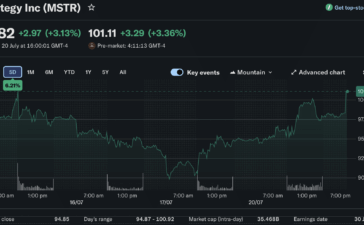
The on-chain data is ugly. Cycle-top buyers who held through the drawdown are finally capitulating, with Glassnode reporting that aggregated realized losses have spiked to $1.3B/day. Long-term bulls are openly stating they aren’t sure Bitcoin recovers this time, or lamenting the opportunity cost of holding Bitcoin while the AI trade minted millionaires. The problems aren’t just price action; fundamental concerns are mounting, as outlined in a viral thread detailing Bitcoin’s current structural issues. Crypto tourists like Brent Johnson are contemplating scenarios where MicroStrategy (MSTR) drops to single-digit support levels.
There are glimmers of hope. DonAlt, the legendary duck, says he will buy “properly” if the weekly candle closes above $71K. That seems all but impossible now, but not in the next couple of weeks. Saifedean Ammous argues that the ultimate backstop remains intact: the narrative that nation-states will buy Bitcoin precisely because it is an asset that cannot be seized by foreign adversaries. The ZEC failure, and a failure all privacy coins suffer currently, strengthens Bitcoin’s primacy as the de facto digital asset store of value.
The altcoin market is faring worse, of course. Delphi Digital declared what we already knew: airdrops don’t work and only create sellers. Builders are exhausted. Algod took to X to voice his frustration with the Bittensor ecosystem, citing unclear conviction and iteration fatigue, while noting that he still holds nearly an ATH amount of TAO but feels his conviction is being seriously tested by a lack of builder incentives.
The old guard of projects are soldiering on. Ryan Sean Adams continues to argue that Ethereum’s value capture mechanism is its use as money—a SoV, MoE, or unit of account. Justin Drake released a long post on the Google quantum computing breakthrough that made many feel Ethereum’s got a great game plan vis-à-vis Bitcoin. Meanwhile, Charles Hoskinson had to clarify that he is not leaving Cardano after ADA dropped 94% back to 2020 levels, prompting critics to beg him to just stop talking.
In a perfect summation of the market’s current feeling, Carl The Moon is officially pivoting to a music career.
Despite the gloom, Hunter Horsley is right: there is a quiet changing of the guard underway in crypto.
The brightest spot is Hyperliquid. HYPE broke all-time highs, proving that tokens can actually perform if they don’t have horrendous tokenomics. Its perpetual volume market share versus centralized exchanges hit 7%. The success even caught the attention of tradfi royalty, with ICE’s Jeff Sprecher noting that it’s bigger than NASDAQ with only 11 people.
But not everyone is convinced. Kyle Samani declared that Hyperliquid is just “Binance 2.0” and will fail due to its centralized technical decisions. This triggered Arthur Hayes to challenge Mr. Samani to a $100k charity wager that HYPE outperforms any top-ten crypto.
Despite this belief in HYPE, Mr. Hayes went from proclaiming “$HYPE to $150”, only to completely dump his HYPE position four days later. In other negative HYPE news, the UK’s FCA published a warning designating Hyperliquid as an unauthorized firm.
Meanwhile in CEX land, Binance announced stock trading on its platform, prompting jokes of being a little late to the party. Coinbase made waves by backing Ethena with open market purchases of ENA.
Perhaps the most fascinating infrastructure shift is the maturity of prediction markets. They’re no longer just for degenerate gambling; they are being actively used for hedging. Rob Hadick notes the sheer volume of teams building sophisticated institutional tooling to place hedging contracts. In a great real-world application, an NYC bar used Kalshi to hedge giving away free drinks if the Knicks win.
Let’s end on some hopium. Chris Perkins pondered whether we might be entering an “alt fundamentals szn” where real product-market fit actually matters. And the hosts of Forward Guidance argued that the massive, concentrated profits currently locked in AI and semis could eventually rotate back to the comparatively starved crypto markets.
-David Sencil