

Economist Peter Schiff has warned that Brent crude’s surge above $100 could reverse June’s 0.4% monthly CPI decline and produce a sharp US inflation rebound in July.
Summary
- Peter Schiff warns oil’s rebound above $100 could drive July inflation sharply higher.
- Brent surged as Houthi attacks and restricted shipping intensified global supply concerns.
- Markets price a 37.6% chance of a Fed rate hike in July.
Peter Schiff linked the risk to oil’s rapid recovery after energy costs helped pull headline inflation below forecasts in June. In a post on X, Schiff noted that crude had already climbed about 30% in July and returned above $90 per barrel when he issued the warning.
“Investors celebrated the June CPI, as a 30% fall in the price of oil led to a larger-than-expected decline. But so far in July, the price of oil is already up 30%, back above $90 per barrel.”
At the time, Schiff estimated that a move to $100 before the end of July would represent a 43% increase from oil’s recent low. Brent crossed that level hours later as attacks on Saudi tankers created another threat to energy shipments from the Middle East.
“If the price hits $100 by month-end, that will be a 43% rise. July CPI could be a doozy!” Schiff added.
Answering a user who asked whether the increase would produce only a temporary supply shock, Schiff argued that June’s improvement depended heavily on cheaper oil. In his view, an even larger July increase could reverse much of that contribution rather than create a new source of inflation.
Oil’s reversal threatens to lift July inflation
June data from the US Bureau of Labor Statistics showed that headline CPI fell 0.4% from May, compared with the 0.1% decline economists polled by Reuters had expected. Annual inflation slowed to 3.5% from 4.2%, also beating the consensus estimate of 3.8%.
Energy prices supplied much of that relief. According to the BLS, the energy index dropped 5.7% during June, its steepest monthly fall since April 2020, while gasoline costs fell 9.7%. Core CPI, which excludes food and energy, was unchanged for the month and rose 2.6% from a year earlier.
Despite June’s monthly fall, the BLS reported that energy prices remained 15.7% higher than a year earlier. Gasoline increased 26.7% over the same period, leaving household costs exposed to another rise if crude prices remain elevated through the rest of July.
Fresh supply concerns have since changed the oil market’s direction. Brent climbed about 7% to $100.71 on Thursday, its highest level in nearly two months, while US West Texas Intermediate moved above $90 for the first time since June.
Oil prices rose following a Houthi attack on two Saudi tankers in the Red Sea and a declared blockade of Saudi-linked shipments through the Bab el-Mandeb Strait. The threat has become more serious because Saudi exporters have relied more heavily on that route while tanker traffic through the Strait of Hormuz remains severely restricted.
According to Reuters, Iranian oil exports have also fallen from as much as 2 million barrels per day to almost zero during the conflict. Goldman Sachs analysts told the news agency that Brent could exceed $120 if disruptions persist, although that forecast depends on the duration and scale of the supply losses.
Diplomatic efforts have yet to restore stable shipping conditions. The US Secretary of State Marco Rubio maintained Washington’s willingness to negotiate but accused Iran of failing to show that it was prepared to reach an agreement. Continued US strikes and Iranian military activity have kept traders focused on possible damage to oil infrastructure and transport routes.
Fed traders still favor a July hold
Higher energy prices have also complicated expectations for the Federal Reserve’s July 28–29 meeting. Fed officials have treated oil as an important influence on headline inflation, while several policymakers have argued that one cooler CPI report is insufficient to establish a lasting downward trend.
Fed Governor Christopher Waller said after the June inflation release that he would need to see “several months” of softer data before becoming confident that inflation was moving back toward the central bank’s 2% target.
Futures traders still favored no change at the July meeting as of July 23. Market pricing showed a 62.1% probability that the Fed would keep its target range at 3.50%–3.75%, while assigning a 37.9% chance to a quarter-point increase, according to data derived from the CME FedWatch Tool.
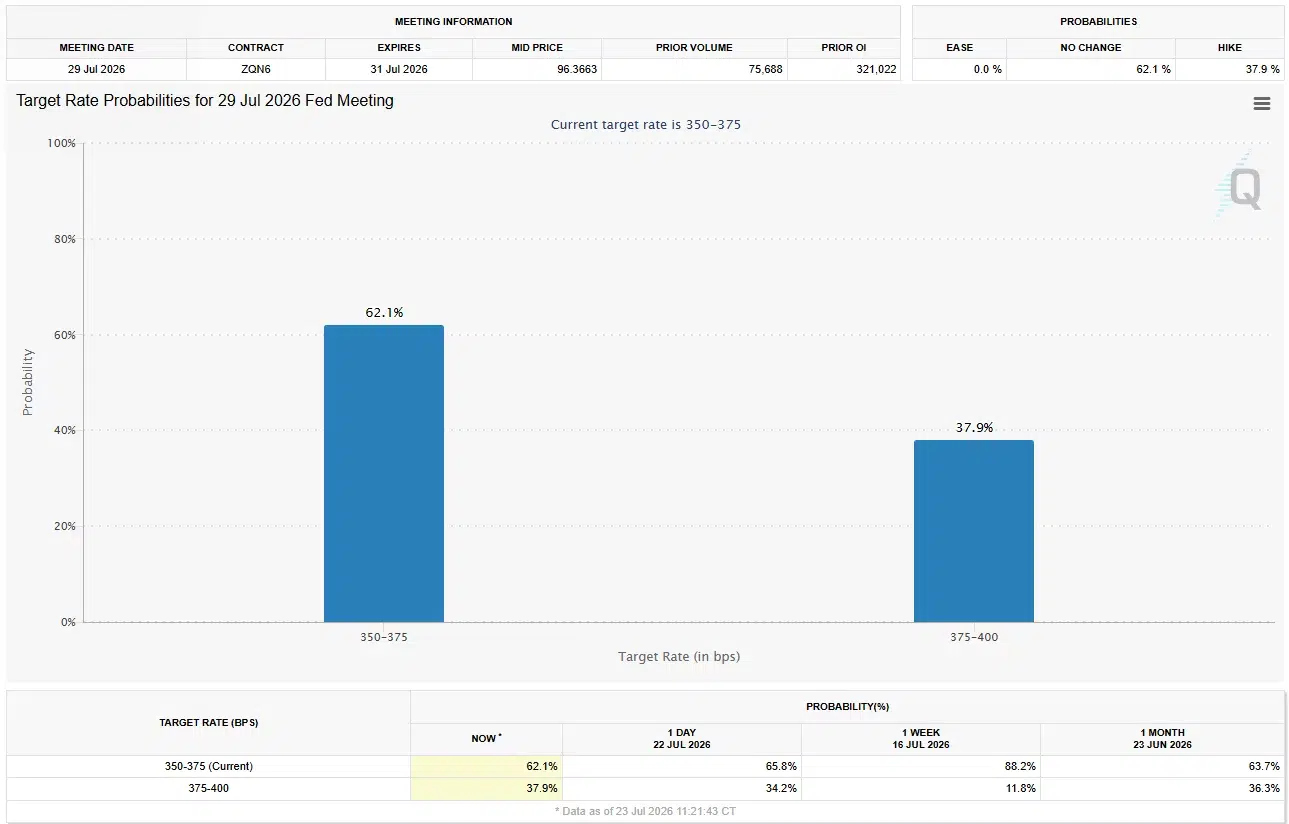
The probability of a July hike has risen sharply since the inflation report. On July 14, traders initially placed only a 10% chance on an increase after June CPI came in below forecasts.
July inflation data will not arrive before the Fed meeting, as the BLS has scheduled the report for Aug. 12. Policymakers will therefore make their decision without knowing the full effect of oil’s rebound, while Schiff’s warning points to energy prices as a potential obstacle to extending June’s inflation progress.