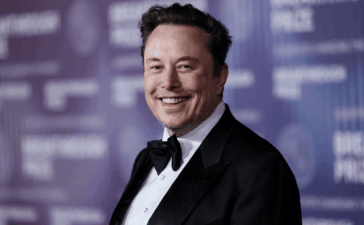
The Elon Musk prediction everyone is talking about came when the billionaire told The Economist that money will effectively cease to exist as a concept within a decade, and that claim lands like a wrecking ball at the foundation of Bitcoin’s core investment thesis.
Speaking in an interview published in late July 2026, Musk predicted that AI will surpass the combined intelligence of all humanity around 2031 and that humans are unlikely to remain in control of AI by 2036.
The central tension this article unpacks is this: if Musk is right that AI-driven abundance makes money irrelevant, does Bitcoin, the asset explicitly designed around scarcity and sound money, become worthless, or does it evolve into something more durable than an inflation hedge?
Elon Musk Prediction: What Musk Actually Said and What It Assumes
In the Economist interview, editor-in-chief Zanny Minton Beddoes summarised the Elon Musk prediction picture as a world in which “money will be irrelevant” because AI-generated abundance will be so extreme that the traditional function of currency collapses.
Musk elaborated separately that he sees money as essentially a “database for labor allocation”; once AI and robots can produce anything anyone needs, that database becomes redundant.
He went further at the World Economic Forum in Davos in early 2026, arguing that AI, robotics, and solar power could unlock economic growth “truly beyond all precedent” and eliminate poverty at scale.
His phrase for the end state: universal high income, not universal basic income paid in cash, but a world of such material surplus that income as a concept dissolves. Michael Burry, the investor famous for his 2008 short, publicly called that specific claim false.
Critically, Musk does not present this as a certainty. He acknowledged that the risk of AI going catastrophically wrong is not zero, with earlier statements placing the probability of a very bad outcome at somewhere between 10 and 20 percent.
Key takeaways from Elon Musk recent interview:
• Humanoid robots will create a quasi-infinite economy. Once you have massive numbers of intelligent robots that can move atoms, the production of goods and services becomes essentially unlimited.
• Money will stop mattering.… pic.twitter.com/lvtVwpRvpx
— maximum (@maximumdegen) July 27, 2026
Bitcoin’s Inflation Hedge Thesis Meets Its Stress Test
Bitcoin’s dominant institutional narrative since 2020 has been built on the assumption that fiat currency would continue to debase, fiscal deficits would persist, and the 21 million fixed supply cap would reward long-term holders.
BlackRock CEO Larry Fink has framed Bitcoin as a legitimate store of value in that inflationary context, and firms like Fidelity have published research explicitly linking BTC’s scarcity to a world of ongoing monetary expansion.
The Elon Musk prediction inverts every one of those assumptions. He predicts deflation, not inflation, as AI and robotics push the marginal cost of goods and services toward zero faster than money supplies grow.
If bread, energy, housing, and medical care all effectively approach zero cost through AI-driven production, the inflation-hedge argument for Bitcoin evaporates alongside the inflation itself.
Corporate Bitcoin adoption strategies anchored to the monetary debasement thesis, the model championed most aggressively by MicroStrategy’s Michael Saylor, face an especially sharp challenge here.
That entire framework assumes humans continue to earn, save, and allocate capital across decades. Musk is arguing the mechanism itself may not survive the 2030s.
Trade BTC on ByBit and Join 99Bitcoin’s Exclusive $1000 USDT Airdrop Campaign
Does Scarcity Still Matter When Abundance Arrives?
The more interesting question for crypto investors is whether Bitcoin’s value proposition can survive its own core argument becoming obsolete. Several threads suggest it might, though none are guaranteed.
First, even in a world of material abundance, governance, identity, and cross-jurisdictional coordination do not resolve themselves automatically.
A censorship-resistant, neutral settlement layer, which is what Bitcoin’s base protocol actually is, retains utility for machine-to-machine payments, AI agent transactions, and jurisdictions that distrust centralized AI operators.
Bitcoin’s trajectory alongside gold, as a scarcity asset, becomes less relevant in this framing; its value shifts toward sovereignty infrastructure.
Second, Musk’s own companies, xAI, Tesla, and SpaceX, represent enormous concentrations of the AI and robotics infrastructure he says will produce abundance.
A world where a handful of AI systems control most productive capacity is not obviously post-scarcity for everyone; it may simply relocate scarcity from goods to access and political power. In that world, a neutral, programmable, uncensorable asset like Bitcoin could matter more, not less.
Third, Musk’s critique of OpenAI’s transformation from a nonprofit to an $800Bn for-profit entity with closed-source models illustrates exactly the centralization risk that Bitcoin’s architecture was designed to resist.
His $150Bn lawsuit against OpenAI was dismissed by a California jury in May 2026, but the underlying tension – who controls the most powerful AI systems and on whose terms – is not resolved by a court verdict.
EXPLORE: Best Crypto Presales With Asymmetric Upside in the Current Market
The post Will the Elon Musk Prediction Prove Right About AI Abundance appeared first on 99Bitcoins.