Key Takeaways
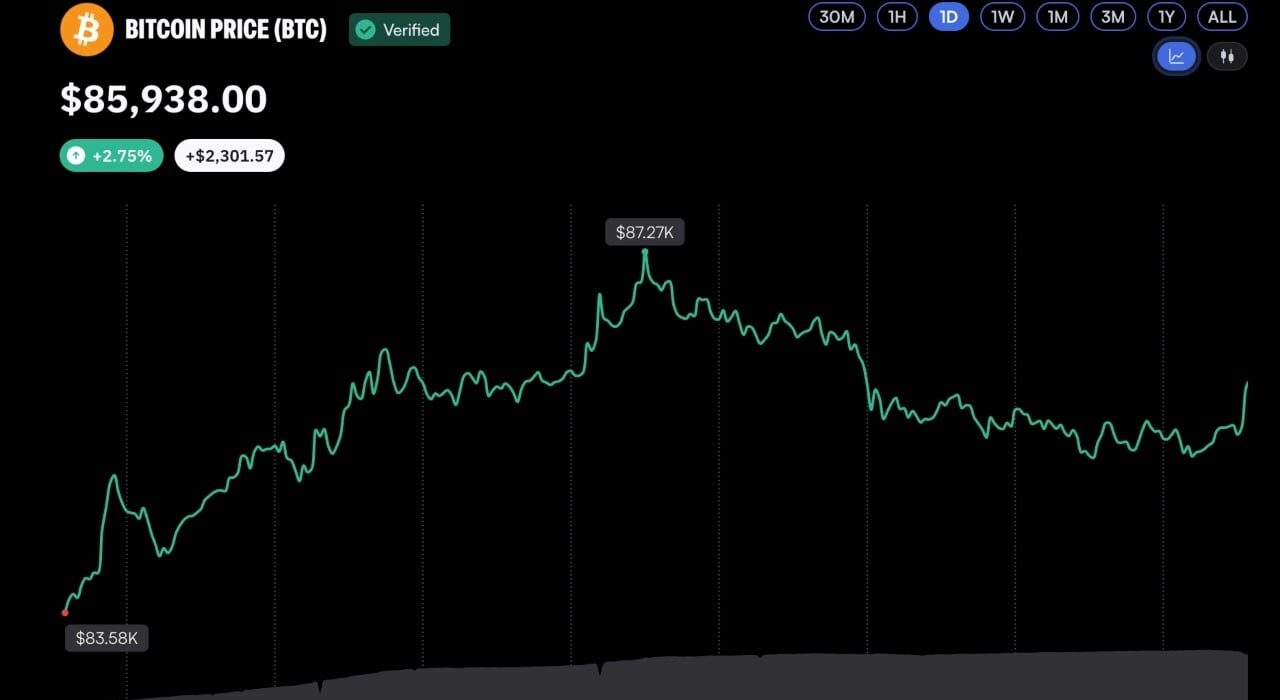
- Bitcoin surpassed $87,300 on Sept. 21 as Santiment recorded the highest social sentiment spike since Dec. 2024.
- $648M in short positions were wiped out in 24 hours, driving total crypto trading volume up 39%.
- Open interest grew 7.6% to $156B, signaling that traders took on new leverage before potential pullbacks.
Short Squeeze Drives Volume Jump
Market sentiment across the cryptocurrency space flipped sharply into bullish territory as bitcoin (BTC) pushed past $87,300, propelled by a major short squeeze and a spike in social volume. According to data from crypto intelligence platform Santiment, crowd commentary around bitcoin and the broader market reached its highest concentration of positive language since December 2024.
That surge in optimism was also reflected in the Crypto Fear and Greed Index, which climbed from 51 a week earlier to 78 on Sept. 21. The 27-point increase moved the gauge from broadly neutral sentiment into the upper end of the greed category, just below the commonly used threshold for “extreme greed.” Taken together, the index and Santiment’s data point to a rapid and broad-based shift in market psychology rather than a rise in sentiment confined to a small group of traders.
In a post on X, Santiment noted that bullish keywords such as higher, bullish and above overwhelmed bearish sentiment on social channels as prices surged, reversing the extreme fear seen in late June when bitcoin fell below $60,000. Santiment said Fear of Missing Out (FOMO) had risen to its highest level in nearly two years, reinforcing the view that traders and investors were increasingly chasing the rally rather than simply responding to improving fundamentals.
The sudden upward momentum was amplified by heavy liquidations in the derivatives market. Roughly $648 million in short positions were wiped out over a 24-hour period, forcing traders with bearish bets to buy back assets to cover their positions. The forced buying coincided with a 39% jump in total crypto trading volume, accelerating price gains and encouraging further FOMO among both retail and institutional participants.
Despite the wave of short liquidations, market leverage continued to build as open interest climbed 7.6% to roughly $156 billion, according to Santiment. The shift suggests traders are adding fresh leverage rather than de-risking. This progression highlights a clear pattern: an initial short squeeze sparked higher trading volume, which ultimately drew leveraged traders back in to chase the rally.
Historical Patterns Signal Caution
Santiment’s social-dominance metrics highlight a stark contrast between recent crowd behavior and current sentiment. A wave of social fear dominated commentary in late June as bitcoin traded below $60,000, ultimately marking a local bottom. In mid-August, a burst of FOMO temporarily stalled rally momentum as prices attempted to move higher.
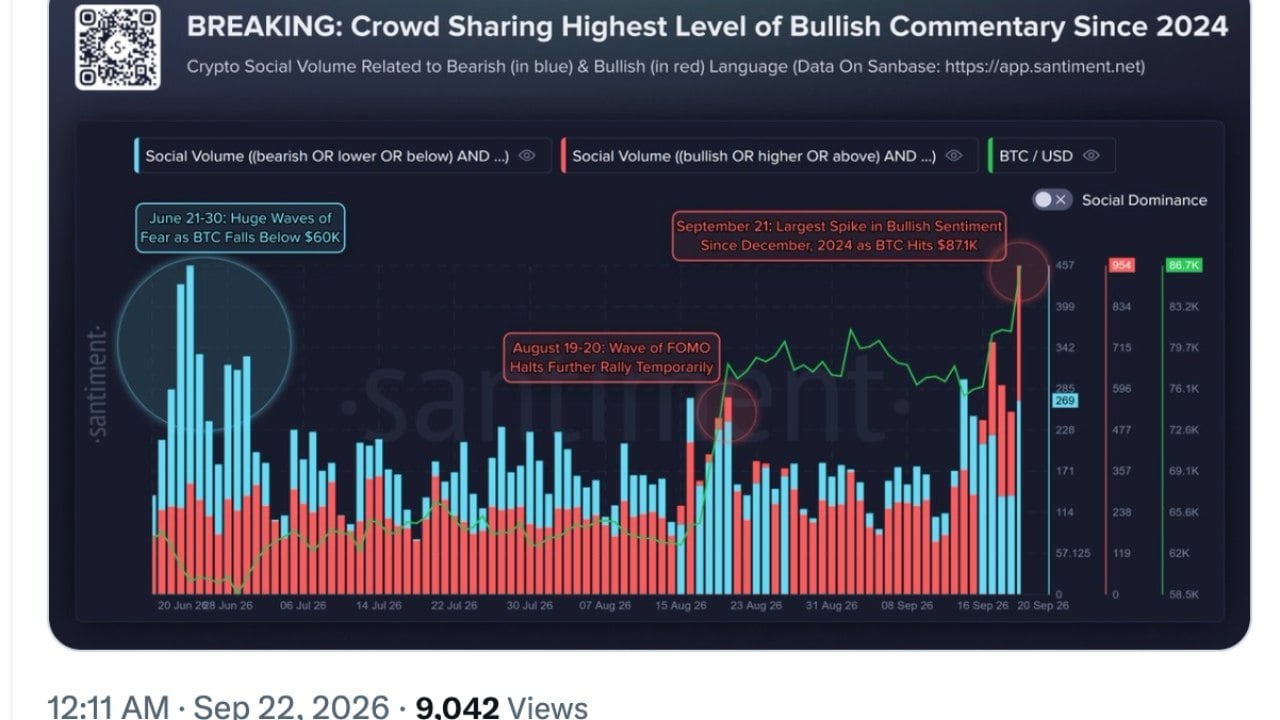
On Sept. 21, however, social sentiment recorded its largest bullish spike since December 2024 as BTC crossed the $87,000 mark. The concurrent rise in the Fear and Greed Index from 51 to 78 strengthens Santiment’s interpretation: optimism is not merely increasing, but becoming unusually concentrated across multiple sentiment measures.
Historically, extreme social consensus tends to act as a contrarian indicator. Synchronized confidence that prices will move “higher from here” often coincides with local tops or consolidation phases, as overcrowded trades leave less liquidity to sustain immediate upside. A Fear and Greed reading of 78 does not guarantee an imminent reversal, and strong markets can remain in the Greed zone while continuing to rise. However, it suggests that the risk-to-reward dynamic is becoming less favorable than when market sentiment was defined by fear.
The broader picture is therefore bullish but increasingly crowded. Continued gains would be more convincing if supported by sustained spot-market demand, controlled funding rates and slower growth in open interest. Conversely, a failure to hold the breakout level while leverage and liquidations rise would increase the risk of a pullback or a broader liquidation cascade.