Disclaimer: This article is for informational purposes only and does not constitute financial advice. BitPinas has no commercial relationship with any mentioned entity unless otherwise stated.
📬 Get the biggest crypto stories in the Philippines and Southeast Asia every week — subscribe to the BitPinas Newsletter.
This article is part of our Consensus HK 2026 Coverage
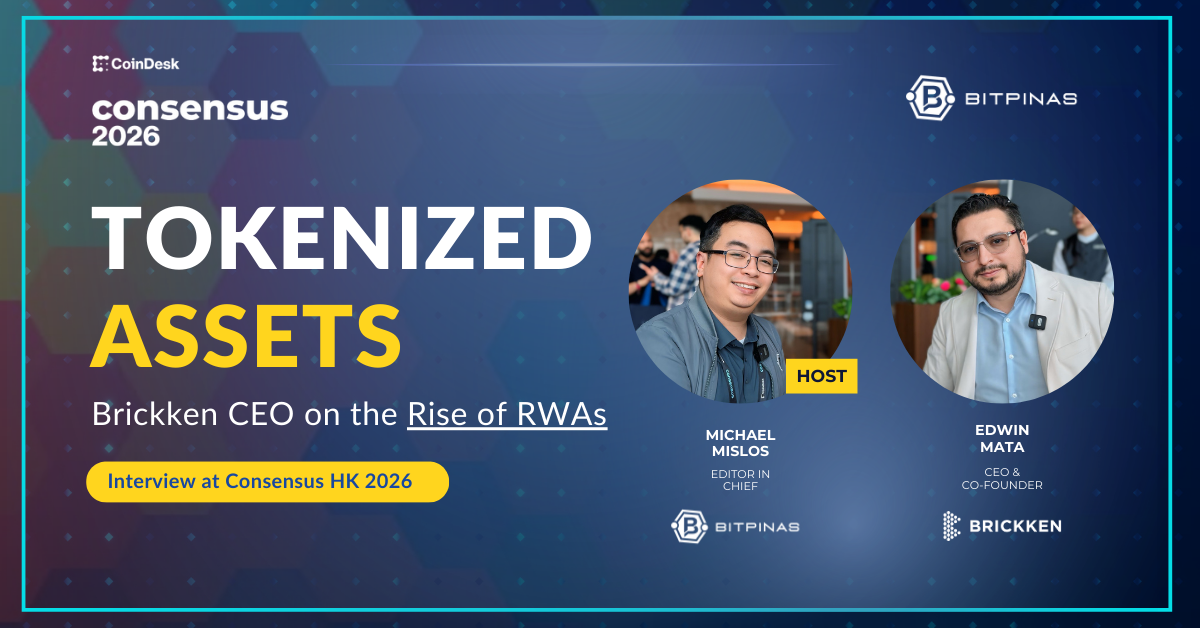
As the tokenization of real-world assets (RWA) moves from experimental pilots to institutional adoption, blockchain platform Brickken has reported grossing over $450 million in tokenized assets across its ecosystem.
In an exclusive interview with BitPinas at Consensus Hong Kong 2026, Brickken CEO and Co-Founder Edwin Mata (LinkedIn, X) discussed the company’s shift beyond real estate, the maturity of the current market cycle, and why developing economies like the Philippines present a stronger use case for tokenization than established European markets.
Beyond Real Estate: The Rise of Gold

While the 2017–2018 market cycle saw a heavy concentration of real estate projects that largely failed to gain traction, Mata noted that the current landscape is significantly more diverse.
“Two years ago, a vast majority of our clients were coming from real estate. But this year, we have gotten a lot of gold,” Mata stated.
He attributed this shift to gold reaching all-time highs, driving asset holders to seek digitization for improved liquidity. Brickken, which operates as a “Tokenization as a Service” platform, allows companies to digitize various asset classes, including credit, debt, bonds, and equity, often within a single day.
From ‘Nice to Have’ to ‘Necessity’
Addressing the failures of early RWA projects in regions like the Philippines, Mata emphasized that while the technology was available in 2018, market maturity was lacking:
“The necessity has always been there, but the maturity (people understanding what blockchain was) was not. We are talking approximately 10 years later now… To last this long, you needed a lot of effort.”
Mata, a former M&A lawyer who transitioned to blockchain to escape the inefficiencies of paper-based restructuring, argued that the current market environment has finally caught up to the technology’s promise.
Open Standards and Vendor Lock-in

Unlike platforms that build proprietary “walled gardens,” Brickken is keen on EIP-7493, an open standard co-developed by the company’s technical team to prevent fragmentation in the tokenization sector.
Mata clarified that the standard is distinct from the Brickken platform itself. “People can use the standard to onboard themselves into tokenization… and it means zero business for Brickken. They don’t need us.”
He argued that this approach is necessary to grow the broader ecosystem, positing that the market is large enough to accommodate multiple players without enforcing vendor lock-in.
Secondary Markets and OTC Potential
Regarding liquidity, Mata revealed that approximately $41 million in Total Value Locked (TVL) within Brickken’s contracts is currently potentially tradable on secondary markets.
While the platform does not yet have formal partnerships with Over-The-Counter (OTC) desks, which currently focus heavily on utility tokens, Mata predicted a shift in the coming year.
“I have no doubts that in the coming 12 months, we will have partnerships with OTCs for RWAs. RWA is going to transform how we see blockchain itself.”
The Philippines Opportunity
Mata, who attended the conference following connections made at Token2049 in Singapore, identified Southeast Asia as a primary growth target. He contrasted the region with markets like Germany, where efficient banking systems make tokenization an “upgrade” rather than a critical solution.
“In Latin countries… and in Southeast Asia, this is a need. You sell faster where it is a need.”
He expressed a specific interest in the Philippine market.
“If anybody listening to this is interested in tokenization, come to us,” Mata said. “I really want to hear from you and understand how we can do tokenization together in the Philippines.”
‘Boring is Stable’
When asked about the criticism that RWAs are “boring” compared to volatile sectors like prediction markets, Mata welcomed the label.
“Boring is stable. Boring is safe. Boring is mature,” he countered.
He noted that while traditional finance (TradFi) institutions are entering the blockchain space, they are doing so through RWAs rather than speculative trends.
“Trends like 2017 tokenization, 2021 NFTs… some died, some survived. We didn’t die. RWA is boring, but it’s going to penetrate the full market without a doubt.”
This article is published on BitPinas: Interview: Brickken CEO Edwin Mata on $450M Tokenized Assets and Why RWAs Are a ‘Necessity’ in the Philippines
What else is happening in Crypto Philippines and beyond?