
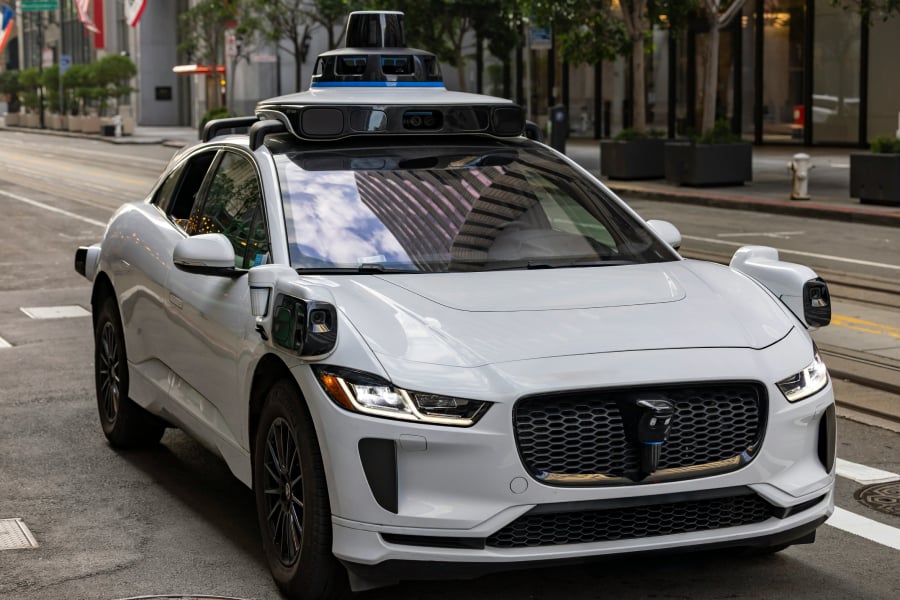
Waymo is putting its own silicon in the driver’s seat.
The autonomous driving unit of Alphabet Inc. revealed on Thursday that it has developed custom chips for its robotaxi fleet, marking the company’s first public look into the hardware platform housed in the trunks of its driverless vehicles.
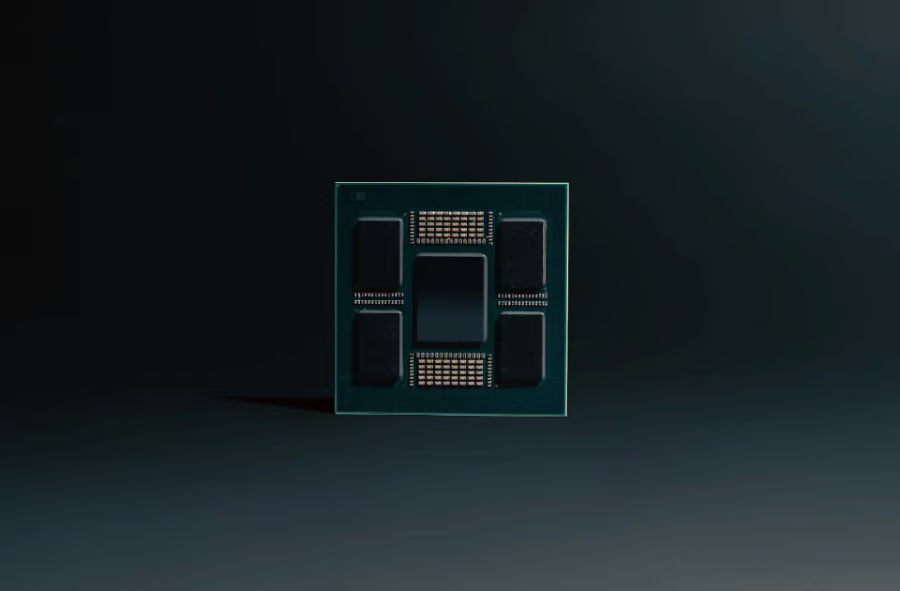
The purpose-built application-specific integrated circuit (ASIC), manufactured using Taiwan Semiconductor Manufacturing Co.’s 5-nanometer process, is designed to digest mountains of raw sensor data before passing information to the core driving system.
Waymo’s custom silicon focuses strictly on the edge ingestion layer rather than managing every vehicle maneuver. The chip cleans up signals, runs temporal denoising for dark driving conditions, and performs sensor fusion across 13 high-resolution cameras, four lidars, and radar feeds.
Collectively, Waymo said the ASICs deliver more than 1,000 trillion operations per second (TOPS) of machine-learning compute.
“We are designing a state-of-the-art system that would be considered impressive for a data center, with the added complexity of an in-vehicle operating domain and real-time requirements,” the company wrote in a blog post.
The computer has to survive the car
Waymo said its onboard computing system is built around three requirements: responsiveness, ruggedness and redundancy.
The system processes driving information onboard within milliseconds, with Waymo saying its compute capacity has increased 20-fold over eight years. It also has to withstand vibration, shocks and extreme temperatures, while using the vehicle’s liquid-cooling system to maintain performance.
Safety adds another challenge. Waymo said its computers operate like two independent engines running workloads in parallel. If one experiences a fault, the other can take over because there is no human driver available to intervene.
More must-read AI coverage
Complementing third-party suppliers
Rather than cutting ties with external chipmakers, Waymo is adopting a hybrid computing architecture.
“We built an ML-primary architecture to run advanced neural networks at minimal latency,” Waymo wrote. “To manage critical non-ML tasks like orchestration, data movement, and logging while maximizing time for ML computation, we pair our ML technologies with the best CPUs, GPUs, and accelerators. The result is a balanced, heterogeneous system.”
The silicon is already entering production in the Ojai, Waymo’s purpose-built passenger vehicle built with Geely-owned Zeekr.
The push into custom silicon comes as Waymo expands commercial services across cities such as Phoenix, San Francisco, and Los Angeles in California, and conducts roughly 500,000 paid trips weekly.
Why Waymo’s custom chips matter
For enterprise technology leaders, Waymo’s move is another sign that specialized AI workloads are pushing companies to rethink how much of their computing stack they want to control themselves. Instead of relying entirely on off-the-shelf processors, Waymo can tune its own silicon around the exact demands of autonomous driving, including latency, power consumption, redundancy, and sensor processing.
That approach will not make sense for every company, but the broader lesson is familiar: as AI workloads become more specialized, hardware choices increasingly shape performance, cost, and reliability. Waymo is applying that equation to vehicles traveling through public streets, where milliseconds matter, and system failures carry consequences far beyond a slow application.
As Waymo expands its robotaxi fleet, its custom silicon could become an important piece of how the company improves efficiency and reliability at scale. For IT leaders watching the rise of purpose-built AI infrastructure, the trunk of a driverless car is becoming another battleground in the custom-chip race.
Also read: As Waymo puts more computing power into its vehicles, the bigger challenge is ensuring the technology can handle the unpredictable real-world situations that emerge as robotaxi fleets scale.