

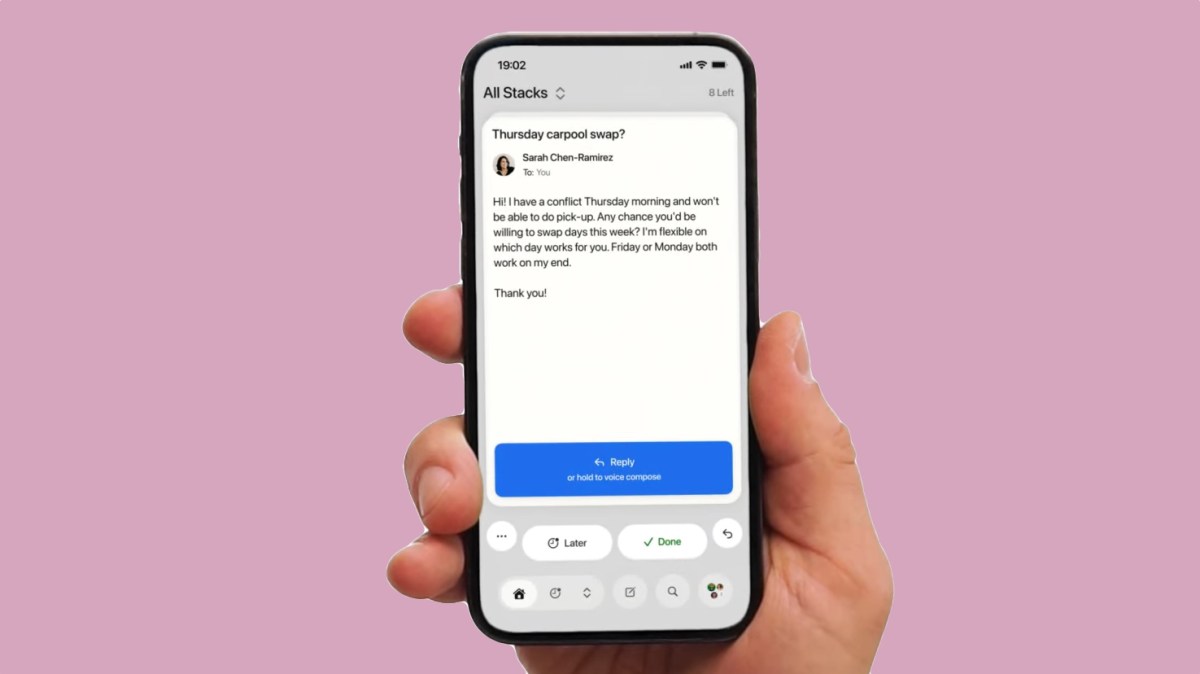
Apps like Superhuman and Mimestream have tried to get people to inbox zero on the desktop. Now, a new app called Avec for mobile devices aims to get you through your inbox using Tinder-style swipe cards and voice-based replies.
The app, initially available on iOS, uses Tinder-style cards where, by default, the left swipe adds the email to a pile that you can address later, and the right swipe adds it to the done (or archive) pile.
The email “stack” of cards also has a button at the bottom that lets you hold it to reply to emails using your voice. When you release the button after speaking, the transcription will show up as a draft. You can review the transcription for errors, make any necessary edits, and then send the email.
Avec said that while apps like Wispr Flow, Willow, and Monolouge exist, they are constrained by Apple’s APIs, and users need to install them as a separate keyboard app to work. Meanwhile, Avec has the full context of your email, so it can understand names and apply better edits based on the tone of the email. Because of this context, the email app can understand your personal email style as well, the company said.


While managing your inbox, Aved lets you mark unimportant emails by swiping down a particular email. The email will learn from what’s put in the unimportant pile and can show it to you in a group instead of forcing you to triage these emails one by one.
While the card-based interface is Avec’s unique feature, it also offers a plain old list-based view.
The app was founded by Jonathan Unikowksi, who previously worked at Replit in a product engineering role. Unikowksi said he was thinking about building tools that he would use every day. He explored ideas like building a browser, but eventually ended up with email.
Techcrunch event
San Francisco, CA
|
October 13-15, 2026
“It’s this thing that hasn’t changed for twenty-five years,” Unikowksi told TechCrunch over a call. He said Gmail was the last big change in email, which has had long-term impacts on how email is managed. “It’s a big part of everyone’s life, no matter how much they hate it. And it seemed very clear to me that through a combination of really good design and, of course, the judicious use of these new AI tools, we could do much better,”


Avec is not alone in having this thought process. Apart from Superhuman, apps like Shortwave and Spike have tried different approaches to presenting email. In the last decade, Basecamp’s Hey has tried to “reinvent” email by becoming a new provider, but, as a paid service, it hasn’t reached the same scale as Gmail.
When I asked Unikowksi about choosing mobile over desktop as a first place to launch an email client, he said that constraints on the platform can force creativity, and the phone is usually the place where people look at their emails.
“I really am a firm believer in this idea that constraints force creativity, and so you get away with a lot less on an iOS app. On phones, you have a very small screen [as compared to the desktop]. You don’t have a physical keyboard. So if you’re going to convince someone to install a new app, it needs to be really good. And for it to be really good, you need to be extremely inventive,” he said.
The app is currently available in the U.S. and is free to use for Gmail users. Support for Outlook is in the works. Unikowksi said that the company plans to introduce paid tiers at some point, but it is still ideating about what features to include within that premium offering.
The company has raised $8.4 million in funding to date from investors, including Lightspeed and Haystack, with participation from individuals such as Replit CEO Amjad Massad, Replit’s head of AI Michele Catasta, Behance co-founder Scott Belsky, and Lenny Rachitsky.