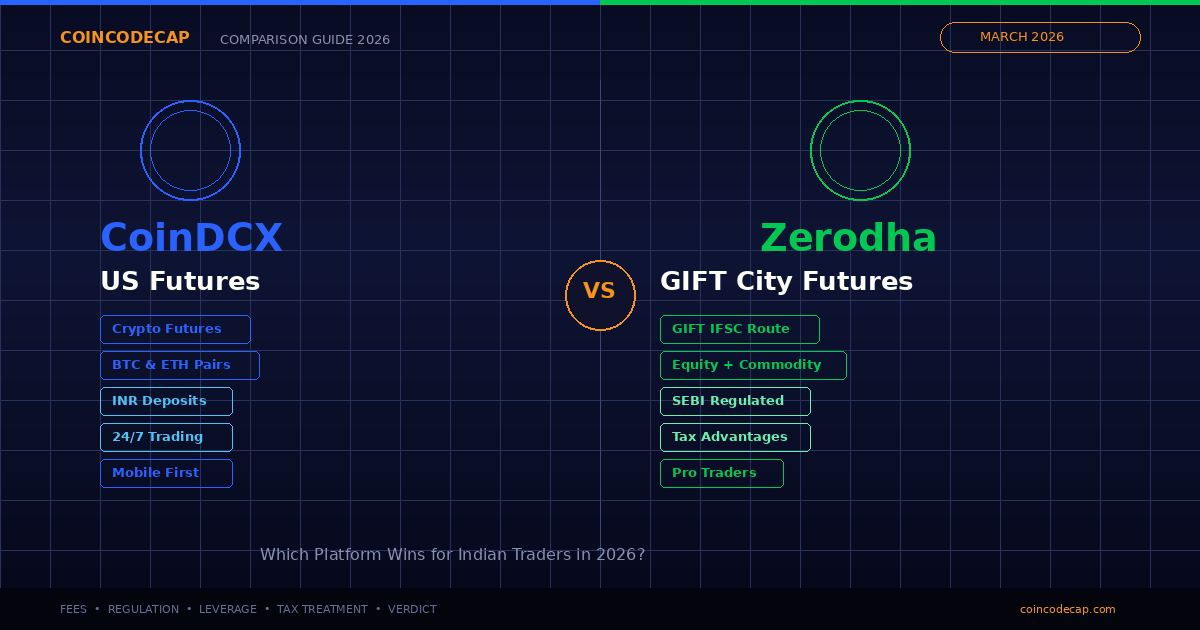
Before you compare these two platforms, there’s one thing you must know: as of March 2026, Zerodha’s US stock product via GIFT City is not live. VP Somnath Mukherjee said in late February 2026 it may launch by April or May. That single fact changes the entire comparison — if you need to trade US stocks today, only one option exists.
That said, Zerodha GIFT City deserves serious analysis. India’s largest broker by revenue, 16 million existing users, IFSCA regulation, UDR-based demat holdings, and a tax structure that unlocks LTCG at 12.5% after 24 months. When it launches, millions of Zerodha users will get US stock access without downloading a new app, opening a new account, or learning a new interface. That’s a distribution advantage no other platform in this cluster can match.
CoinDCX went in a completely different direction — perpetual INR-settled contracts, no LRS, no TCS, 20x leverage, short-selling, and IMPS deposits that settle in 2 minutes. It’s been live and iterated on for years. These are different tools, suited to fundamentally different investors.

| Quick Answer: CoinDCX US Futures is the clear winner for active traders who need leverage, short-selling, 24/7 access, or want to avoid LRS/TCS entirely — and it’s available right now. Zerodha GIFT City, once launched (expected Apr–May 2026), will be the better choice for Zerodha’s 16 million existing users building long-term US portfolios with LTCG treatment at 12.5% and demat-based UDR ownership. Running both platforms in parallel is a legitimate strategy. |
For on-demand analysis of any cryptocurrency, join our Telegram channel.
Table of Contents

Platform Score Cards
| Feature | CoinDCX US Futures | Zerodha GIFT City (US Stocks) |
| Status — March 2026 | Live, fully operational | ⚠ NOT YET LIVE — expected Apr–May 2026 |
| Product type | INR-settled perpetual futures | UDRs / direct US stocks via NSE-IX or India INX |
| Minimum investment | ₹100 | ~$10 (fractional UDRs) |
| Leverage | Up to 20x | None (1x only, LRS rule) |
| Short selling | Yes | No |
| 24/7 trading | Yes | US hours only (approx. 7:30 PM–1:30 AM IST) |
| Asset count | ~20 US stocks & 2 indices | 50+ UDRs (NSE-IX) or 80+ exchanges (India INX) |
| Deposit method | IMPS / NEFT | LRS bank transfer (SWIFT or domestic GIFT bank) |
| Deposit speed | ~2 minutes | 2 hours–3 business days |
| Forex conversion | None — INR-settled | LRS remittance — TCS 20% above ₹10L |
| Demat account | Not required | Yes — holdings in existing Zerodha demat |
| SEBI / IFSCA reg. | FIU-IN, ISO 27001:2022 | IFSCA (India’s GIFT City regulator) |
| SIPC protection | No | Not applicable (IFSCA regulated, not SEC) |
| US estate tax | No (INR contract) | Possible — UDR structure debated |
| Actual share ownership | No | Yes — UDR in demat account |
| Dividends | No | Yes (25% US WHT + 10% HDFC IFSC service charge) |
| LTCG treatment | No — business income (slab) | Yes — 12.5% after 24 months |
| LRS limit applicable | No | Yes — $250K/year |
| Zerodha ecosystem | No | Yes — Kite, Console, Coin all connected |
| Existing user advantage | None | 16M Zerodha users: no new app, same login |
The Elephant in the Room — Zerodha GIFT City Isn’t Live Yet
Every comparison article currently being published about Zerodha GIFT City is comparing a live product to an announcement. That’s worth naming clearly.
Zerodha announced US stock access via GIFT City in October 2025. Their VP said at a conference in late February 2026 the launch could come by April or May. No fee structure has been disclosed. The exact stock universe isn’t public. The precise LRS routing mechanics, TCS handling, and UDR custodian arrangements haven’t been confirmed for the Zerodha-specific product — though the GIFT City infrastructure (NSE-IX UDRs + HDFC Bank IFSC custodian + CDSL demat) is well-understood from other platforms already using it.
What this means for you: If you need US stock exposure in March 2026, CoinDCX is your only option between these two. If you’re a Zerodha user willing to wait 6–10 weeks, the GIFT City product could be worth that wait — particularly if you’re building a long-term portfolio targeting LTCG.
Feature-by-Feature Winner Ranking
| Category | Winner | Why |
|---|---|---|
| Trading Speed | CoinDCX ✓ | IMPS 2 min vs SWIFT 2–3 days |
| Leverage | CoinDCX ✓ | Up to 20x vs none (LRS rules) |
| Short Selling | CoinDCX ✓ | Yes on all listed stocks vs no |
| 24/7 Access | CoinDCX ✓ | Always open vs US market hours only |
| LRS / TCS Avoidance | CoinDCX ✓ | Zero LRS vs 20% TCS above ₹10L |
| Asset Universe | Zerodha ✓ | 50+ UDRs vs ~20 futures contracts |
| SEBI / IFSCA Regulation | Zerodha ✓ | IFSCA regulated vs FIU-IN only |
| Demat Integration | Zerodha ✓ | Same Kite demat — no new account |
| LTCG Tax Rate | Zerodha ✓ | 12.5% after 24m vs slab rate (30%) |
| Dividends | Zerodha ✓ | Yes (net of WHT) vs no dividends |
| Zerodha Ecosystem | Zerodha ✓ | 16M existing users, same login |
| Availability Now | CoinDCX ✓ | Live today vs Apr–May 2026 launch |
| Final Score | CoinDCX: 6 | Zerodha: 6 — tied overall, different use cases |
What GIFT City Changes for Indian Investors
GIFT City — Gujarat International Finance Tec-City — is treated as international territory under FEMA, regulated by the IFSCA (not SEBI, not RBI for these transactions). When you invest via GIFT City, your money moves domestically between Indian bank accounts before reaching the GIFT City framework. Contrast this with traditional LRS routes, where funds physically travel via SWIFT to a US broker.
The key structural advantage: UDRs (Unsponsored Depository Receipts) issued on NSE-IX are held in your Indian demat account via CDSL’s IFSC unit. Not in a US broker’s pool account. Not subject to US SIPC recovery timelines. Your holdings stay within India’s regulatory framework. That’s a meaningful safety argument, though SIPC’s $500K protection is also a meaningful counter-argument depending on your risk preference.
Tax treatment on GIFT City UDRs mirrors Indian capital gains rules: LTCG at 12.5% after 24 months, STCG at slab rate for shorter holds. Dividends carry 25% US withholding tax plus a 10% HDFC IFSC service charge — effective 32.5% on dividends, which is notable for income-focused investors.
One thing GIFT City does not change: LRS still applies. Your annual $250,000 limit is consumed, and TCS of 20% applies on amounts above ₹10 lakh per year. This is identical to Vested, INDmoney, Angel One and Winvesta. CoinDCX remains the only platform in this comparison cluster where INR never leaves India’s financial system.
CoinDCX vs Zerodha: Fee Comparison
CoinDCX charges 0.007%–0.05% to enter a position, then funding accumulates at 4–8% p.a. on notional, debited three times daily. A ₹10,000 position held for 14 days at 6% funding costs approximately ₹230 all-in.
Zerodha’s GIFT City fee structure hasn’t been publicly disclosed yet. Based on NSE-IX UDR trading at comparable platforms: typical brokerage is zero or ~₹20 per order, with exchange transaction charges on top. The real recurring cost is LRS-related — the bank forex conversion at the point of remittance, which varies by bank (typically 0.5%–1.5%) plus the TCS obligation above ₹10 lakh.
| ⚠ Fees not yet confirmed Zerodha has not disclosed the exact fee structure for its GIFT City US stock product. This comparison uses publicly available NSE-IX UDR fee data from similar IFSCA brokers. Verify current fees directly with Zerodha once the product launches. |
Tax Comparison & Platform Verdict
CoinDCX US Futures
30%
Business income — slab rate
Tax on ₹5L profit
₹1,50,000
Net in hand: ₹3,50,000
Zerodha GIFT City
12.5%
LTCG after 24 months
Tax on ₹5L profit
₹62,500
Net in hand: ₹4,37,500
Saving with Zerodha GIFT City LTCG
₹87,500
more in your pocket — on the same ₹5 lakh gain
Platform Verdict — Who Wins Each Use Case
2 Real Scenarios
| Scenario 1: The Zerodha F&O trader adding US exposure Vikram has been trading Indian F&O on Zerodha for 4 years. He knows the Kite interface cold. When Zerodha’s GIFT City product launches in April–May 2026, he’ll be able to add 50+ US UDRs directly inside Kite — same login, same demat, no new KYC.
He buys ₹2 lakh of NVIDIA UDRs and plans to hold for 2+ years for LTCG. His tax on a ₹50,000 gain: ₹6,250 at 12.5%. Via CoinDCX at 30% slab: ₹15,000. He can wait 6 weeks for the Zerodha launch. → Zerodha GIFT City (when live) — seamless for existing users, LTCG treatment, demat ownership. |
| Scenario 2: The NVIDIA earnings short Neha is bearish on NVIDIA going into results. She wants 5x short exposure for 48 hours, no SWIFT delay, and the ability to act right now — not in 6 weeks. Sunday 10 PM IST: she opens a CoinDCX short on NVIDIA with ₹20,000 margin at 5x.
NVIDIA drops 8% post-earnings; her position returns ₹8,000 on ₹20,000 (40%). Funding cost for 48 hours: ₹66. Zerodha GIFT City cannot execute this trade even after launch — no leverage, no short-selling, US hours only. → CoinDCX — leverage, shorts, instant execution, live now. |
Decision Framework
| Situation | Best platform |
| Need leverage on US stocks | CoinDCX |
| Need short-selling on US stocks | CoinDCX |
| Trading events, earnings, macro news | CoinDCX |
| Need to act within 2 minutes of news | CoinDCX |
| Want to avoid LRS / TCS paperwork | CoinDCX |
| Need a product that’s live right now | CoinDCX |
| Building 24-month+ US stock portfolio | Zerodha GIFT City (when live) |
| Want LTCG 12.5% on US gains | Zerodha GIFT City |
| Already using Zerodha — don’t want a 2nd app | Zerodha GIFT City |
| Want UDR demat holdings vs exchange exposure | Zerodha GIFT City |
| Comfortable with IFSCA regulation | Zerodha GIFT City |
Frequently Asked Questions
Is Zerodha GIFT City live in March 2026?
No. As of March 2026, Zerodha’s US stock product via GIFT City is not available to retail users. Zerodha VP Somnath Mukherjee said at GSMC 2.0 in late February 2026 that the launch may come by April or May 2026. No fee structure, exact stock universe, or onboarding process has been officially confirmed yet. If you need US stock exposure before then, CoinDCX US Futures is the only operational platform in this comparison.
What are UDRs, and how is this different from buying actual US shares?
Unsponsored Depository Receipts (UDRs) are instruments issued by Indian depositories (CDSL’s IFSC unit) that track the price of US-listed stocks. They’re denominated in USD, held in your Indian demat account, and subject to Indian regulatory jurisdiction under IFSCA. Unlike direct US share ownership via Vested or Winvesta (where your shares sit in a US broker’s custodial account), UDRs stay inside India’s financial system. You receive equivalent price exposure and dividend income (net of US WHT and HDFC IFSC charges), but you don’t hold the underlying US share directly. SIPC doesn’t apply — IFSCA regulation does.
Can existing Zerodha users access the GIFT City product without a new account?
Based on Zerodha’s announced approach, the product will integrate into Kite using your existing demat account. This is a genuine advantage — 16 million Zerodha users won’t need to open a new brokerage account, complete new KYC, or learn a new interface. However, a GIFT City bank account or IFSC sub-account may be required for the LRS remittance leg. The exact onboarding process hasn’t been confirmed — verify with Zerodha directly once the product launches.
Does LRS still apply to Zerodha GIFT City investing?
Yes. Remittances to GIFT City for equity investing still fall under LRS for resident Indians — your annual $250,000 limit applies, and TCS of 20% is levied on transfers above ₹10 lakh per year. This is the same as every LRS-route platform. CoinDCX US Futures remain the only product in the India US-stocks space where no LRS is consumed and no TCS applies, because INR never crosses a border.
If I can only choose one platform right now, which should I pick?
If your investment horizon is under 30 days or you need leverage or short-selling: CoinDCX, no contest. If you’re planning to build a diversified US portfolio for 2+ years and you’re already a Zerodha user: wait 6–10 weeks for the GIFT City launch — the LTCG tax saving of ₹87,500 on every ₹5 lakh gain is worth the wait. If you’re not a Zerodha user and need LRS-based US stock ownership now, consider Winvesta (lowest forex markup, dual FCA+SIPC regulation) while waiting to see Zerodha’s final fee structure.
Read More in the Series
For on-demand analysis of any cryptocurrency, join our Telegram channel.