
The digital asset ecosystem increasingly depends on data infrastructure that is accurate, real-time, and capable of supporting advanced trading systems and multi-chain analytics. CoinMarketCap (CMC) and CoinGecko (CG) remain popular aggregators, but they rely primarily on centralized exchange (CEX) data. Bitquery’s Crypto Price API takes a fundamentally different approach by delivering on-chain, deterministic, multi-level, real-time pricing combined with Kafka, GraphQL, and WebSocket infrastructure for enterprise scalability.
This article provides a detailed comparison suitable for CTOs, quant developers, data engineers, and DeFi builders evaluating which provider best fits modern crypto infrastructure demands.
| Feature | CoinMarketCap | CoinGecko | Bitquery |
|---|---|---|---|
| Data Source | CEX-reported | CEX-reported + metadata | On-chain blockchain data |
| Real-time streaming | No | No | GraphQL WebSocket + Kafka |
| Enterprise ingestion | No | No | Kafka (high throughput) |
| API style | REST | REST | GraphQL, WebSocket, Kafka, REST-like |
| Price granularity | Token-level | Token-level | Pair-level, Token-level, Currency-level |
| USD valuation for any token | No | No | Yes (multi-hop routing) |
| DEX coverage | Minimal | Limited | Comprehensive multi-chain |
| New token listing | Slow | Moderate | Instant on first on-chain trade |
| Historical resolution | Minutes–Daily | Minutes–Daily | Tick-level + custom OHLCV |
| Cross-chain support | No | No | 40+ blockchains |
1. Overview of Key Differences
CoinMarketCap (CMC)
A centralized exchange data aggregator focused on mainstream metrics such as market cap, supply, rankings, and broad price referencing.
CoinGecko (CG)
A flexible aggregator offering developer activity metrics, community signals, trending tokens, and metadata with a more developer-friendly free tier.


Bitquery Crypto Price API
A blockchain-indexing platform delivering on-chain trade-level price analytics, multi-chain coverage, and enterprise-grade data delivery through:
- GraphQL API
- GraphQL WebSocket Streaming
- Kafka high-throughput pipelines
- Multi-level price intelligence (pair, token, currency)
- Chain-agnostic USD valuation for any on-chain token
Bitquery’s architecture is closer to premium financial data providers (e.g., Bloomberg, Refinitiv, Kaiko) than traditional aggregators.
2.1 CMC & CoinGecko: Off-chain Exchange Aggregation
Both platforms aggregate CEX-reported prices. Limitations include:
- Non-verifiable off-chain data
- Delays in listing new tokens
- Exposure to exchange API downtime
- Wash trading inflating reported volumes
- Lack of real-time DEX activity
2.2 Bitquery: On-chain Deterministic Price Discovery
Bitquery computes prices from raw blockchain events across 40+ chains. Every trade, swap, and liquidity event is indexed and normalized.
Benefits:
- Sub-second latency
- Guaranteed provenance directly from blockchain
- Real-time pricing even for newly launched tokens
- Accurate cross-DEX and cross-chain aggregation
- Tick-level granularity
This makes Bitquery the only solution among the three capable of supporting trading engines, DEX analytics, MEV systems, arbitrage bots, and compliance systems at production scale.
3. Multi-Level Price Intelligence
(Uniquely Provided by Bitquery)

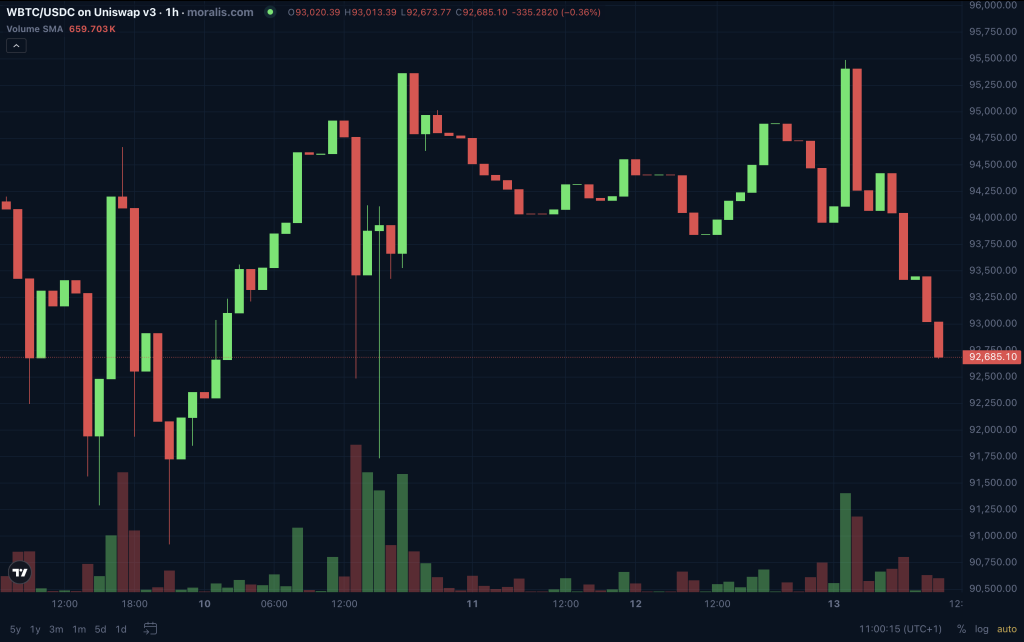
Bitquery provides price intelligence at three precision layers:
3.1 Pair-Level Price Data
Granular price information directly from specific liquidity pools (e.g., Uniswap, PancakeSwap, Curve).
Includes:
- Swap-level prices
- Liquidity per pool
- Pool-specific OHLCV
- Slippage & price impact
- DEX-pair real-time execution feed
Ideal for: arbitrage, market making, liquidity tracking.
3.2 Token-Level Aggregated Data
Bitquery aggregates all trading activity for a token:
- Across all pools
- Across all DEXs
- Across all blockchains
Delivering:
- Weighted token price
- Token-level OHLCV
- Aggregate volume and liquidity
- Token-level historical analytics
3.3 Currency-Level Data (USD, ETH, BTC, etc.)
Bitquery normalizes prices into any base currency, including USD, even when no direct stablecoin pair exists. It uses multi-hop, cross-pool price routing:
TOKEN → DEXPAIR → STABLECOIN → USD
This enables USD valuation for any token that trades on-chain, including long-tail assets and brand-new launches.
CMC/CG cannot provide this for unlisted or thinly listed tokens.
4. Enterprise Data Delivery: Kafka, GraphQL, WebSockets
4.1 GraphQL API
Bitquery uses GraphQL for highly flexible, structured access to:
- Trades
- Prices
- Pools
- Liquidity
- Transfers
- OHLCV
- Address-level analytics
This enables a single query to fetch complex, multi-source datasets.
4.2 GraphQL WebSocket (Real-time Streaming)
For:
- Live trading feeds
- Arbitrage systems
- DEX monitoring
- Transfer monitoring
- Wallet balance systems
- Liquidation bots
WebSockets push data as soon as blocks arrive, supporting sub-second latency.
4.3 Kafka Interface
Bitquery is the only provider among the three offering a Kafka interface.
Kafka enables:
- High-throughput ingestion
- Fault-tolerant pipelines
- Distributed processing across analytics clusters
- Integration with Spark, Flink, Snowflake, Redshift, BigQuery
- Real-time quant infrastructure
- Enterprise risk and compliance systems
Streams available via Kafka:
- On-chain trades (tick-level)
- Cross-chain price updates
- Pool and liquidity events
- Large holder movements
- First-trade token listings
- Arbitrage-relevant flows
This positions Bitquery as an enterprise-grade market data provider on par with institutional financial data vendors.
CMC and CG offer no equivalent for streaming or enterprise ingestion.
5. Use Case Suitability
CoinMarketCap
Best for: consumer-facing price charts, simple market metrics.
CoinGecko
Best for: metadata, social metrics, NFT/trending categories, hobby developer dashboards.
Bitquery
Best for:
- Quant trading
- HFT and arbitrage systems
- Institutional analytics
- DeFi platforms
- Wallets and explorers
- Token launch tracking
- Compliance, AML, and surveillance
- Enterprise data engineering pipelines
For any application requiring real-time, on-chain, enterprise-grade data, Bitquery is superior.
6. CoinMarketCap vs CoinGecko vs Bitquery Crypto Price API: Conclusion
CMC and CG are powerful aggregators for top-level consumer price data. However, they lack the verifiability, latency, coverage, and infrastructure demanded by modern crypto trading and DeFi systems.
Bitquery’s combination of:
- On-chain trade-level precision
- Multi-level (pair/token/currency) pricing
- USD valuation for any token
- GraphQL data modeling
- Low-latency WebSocket streaming
- High-throughput Kafka enterprise pipelines
makes it the most advanced and scalable crypto data infrastructure in this comparison.
CoinMarketCap vs CoinGecko vs Bitquery: Which Crypto Price API Is Best?
If you’re building a trading bot, DeFi dashboard, analytics product, market-making system, or institutional data pipeline, the quality of your price feed determines reliability. This blog compares the three leading crypto data APIs—CoinMarketCap, CoinGecko, and Bitquery—to help you choose the right one.
Short answer:
CoinMarketCap = consumer metrics
CoinGecko = flexible metadata + developer-friendly
Bitquery = real-time, on-chain, multi-chain, enterprise-grade crypto price API
What Makes Bitquery Different?
tquery uses on-chain blockchain data, not exchange-reported prices. This allows Bitquery to provide:
Real-time prices from DEX swaps
Pair-level, token-level, and currency-level price intelligence
USD valuation for ANY token traded on-chain
GraphQL APIs for flexible data modeling
WebSocket real-time feeds
Kafka streams for enterprise-scale ingestion
No other provider in this comparison offers these capabilities.
Why Enterprises Prefer Bitquery
query because it delivers:
Sub-second indexing
Deterministic on-chain provenance
Scalable streaming via Kafka
Multi-chain support across 40+ blockchains
Tick-level and OHLCV historical data
Immediate support for new token launches
This makes Bitquery suitable for advanced workloads like arbitrage detection, MEV analysis, risk modeling, and real-time compliance.