
Disclosure: CoinCodeCap has no commercial relationship with Liquid and earns nothing from this page. Liquid runs an affiliate program, but we haven’t joined it, so none of the links below pay us.
How we reviewed this: fees, markets, custody, referral terms and legal terms were checked against Liquid’s own documentation and its Terms of Service (last updated 17 September 2026) on 23 September 2026. Usage figures come from DeFiLlama’s public record of the fees Liquid earns on Hyperliquid. Funding details come from Liquid’s team page and Fortune’s report on its Series A. We did not fund an account, so nothing below describes live fill quality. The review was researched and drafted with AI assistance, and every figure was re-checked against the linked sources before publication.
Search “liquid trade” and you’ll find several unrelated companies. One is a crypto exchange that went down with FTX. Others are online brokers that Liquid’s own docs go out of their way to disown. The one this review covers is Liquid at liquid.trade, a trading app launched in 2025 that lets you go long or short on Bitcoin, Tesla, gold, the euro and even OpenAI from a single balance.
Unlike many apps built on Hyperliquid, its usage hasn’t faded after launch. In August 2026 it earned about $130,000 in fees on Hyperliquid alone, roughly ten times what the mobile app Dexari earned in the same month.
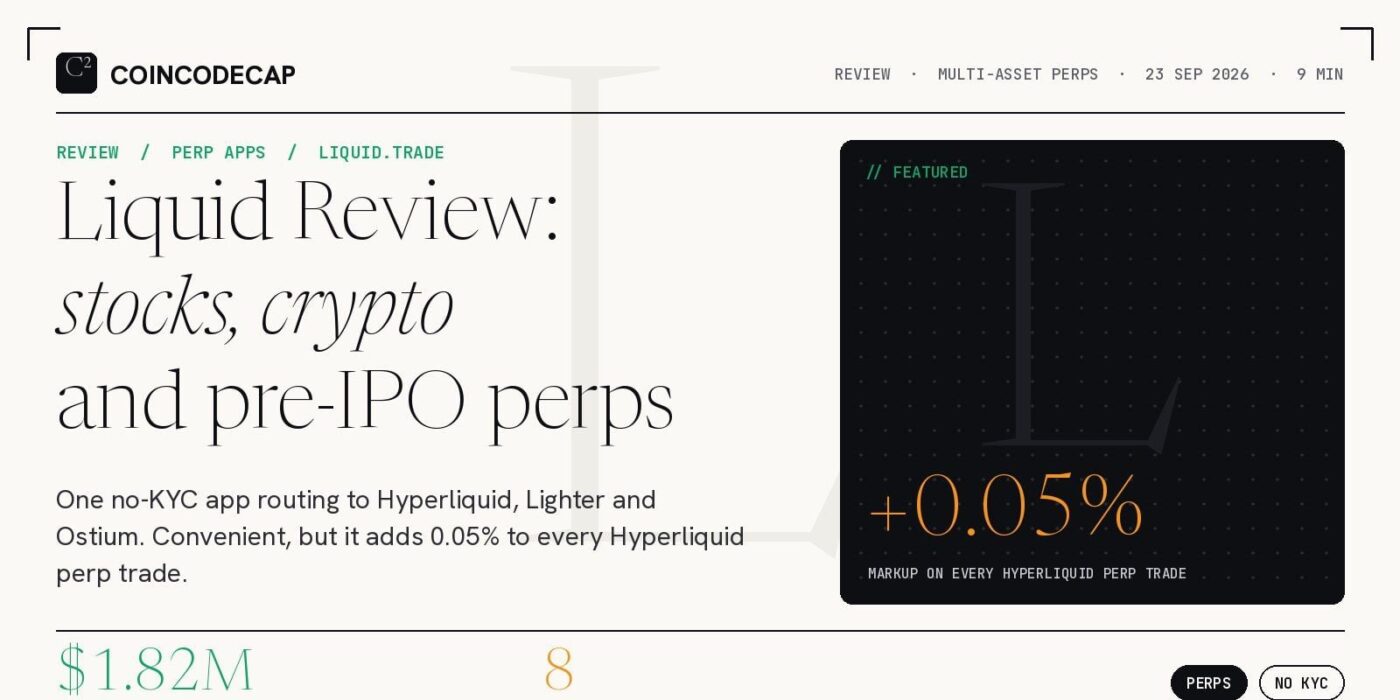
TL;DR: Liquid is a non-custodial app that sends your orders to other exchanges: Hyperliquid and Lighter for crypto, and Ostium for stocks, FX and commodities. You sign in with email, Google or Apple, there’s no KYC, and markets run 24/7 with up to 40x on crypto and 50x on FX and indices. Price is the catch. On Hyperliquid-routed perps, Liquid adds 0.05% to every trade, which more than doubles what a new trader pays compared with using Hyperliquid directly. You’re paying for convenience, a wide market list and an AI assistant, and whether that’s worth it depends on how much you trade.


Which Liquid is this?
The app’s docs spell out that it has nothing to do with Liquid Brokers, liquidmarkets.org or the former Liquid exchange run by Quoine. That old exchange was hacked in 2021, bought by FTX, and paused all trading when FTX collapsed. If you had money there, this app can’t help you get it back.
Today’s app is run by LiquidX AI, Inc., a Delaware company. It was founded in 2025 by Franklyn Wang, formerly Chief AI Scientist of Macro at Two Sigma. It has raised more than $25.6 million: a $7.6 million seed round in November 2025, then an $18 million Series A in April 2026 led by Neo and Left Lane Capital. The only official domains are liquid.trade and its subdomains.
How Liquid works: one account, three exchanges underneath
The app doesn’t run an order book of its own. It’s a front end that routes each order to a venue that does:
- Crypto perps go to Hyperliquid or Lighter.
- Stocks, commodities, FX and indices mostly go to Ostium, a perps exchange on Arbitrum built for real-world assets.
- Pre-IPO and prediction markets sit in the same app, but the docs don’t name the venue behind them.
You see one balance, but margin doesn’t fully work that way underneath. The margin docs say cross margin generally applies within one venue, so a Hyperliquid position and an Ostium position are margined separately. The app moves collateral between venues for you when you open a trade, and the order ticket shows which margin it’s using.
Liquid fees: what a $10,000 trade costs
The fee page is unusually clear. On crypto perps it adds a flat 0.05% on top of the venue’s fee and publishes the all-in rate. Tiers depend on your rolling 14-day volume, and spot volume counts double toward them.
Tier 0’s taker rate is Hyperliquid’s base taker fee of 0.045% plus Liquid’s 0.05%, so the arithmetic checks out. On a $10,000 BTC market order that you open and later close, the bill looks like this:
So a new trader pays a little over twice what Hyperliquid itself charges. Even at the top tier the 0.05% markup stays, because it’s added at every level. Lighter-routed markets are the exception: Liquid says it adds nothing there, and Lighter’s standard accounts charge no trading fee, as our Lighter review covers.
The other asset classes are priced differently:
- Spot crypto: no Liquid fee at all, only the venue’s rate.
- Stocks, FX, commodities and indices on Ostium: Ostium charges only on entry (5 bps on stocks and indices, 3 bps on most FX, 3 to 20 bps on commodities), and Liquid adds 5 bps. A $10,000 Tesla position costs about $10 to open, and Ostium charges nothing on exit.
- Prediction markets: free to open, 0.9% when you sell or the contract closes.
- Withdrawals: a flat $1 in USDC. Crypto deposits are free, and card or bank deposits carry the payment provider’s charge.
Funding payments pass between traders and aren’t a Liquid fee, though they still hit your P&L on longer holds. Our Hyperliquid fees guide explains how the base layer charges.
Markets: 200+ crypto perps, stocks, pre-IPO and prediction markets
This is where Liquid stands out. From one account you can trade:
Every perp trades around the clock, including weekends. That’s useful, but risky too. A Tesla perp can move on Saturday news while the Nasdaq is shut, then snap back toward the real price on Monday morning.
Pre-IPO perps need extra care. The docs say they track “reference valuations” of private companies, but with no public share price there’s nothing for the market to anchor to, and the price can jump when a company finally lists. The same idea is on offer at trade.xyz, which launched pre-IPO markets on Hyperliquid. For event trading, the prediction markets use a separate balance; compare them with the options in our crypto prediction markets guide and Polymarket alternatives list.
Co-Invest: the AI assistant that can place trades
Liquid’s other selling point is Co-Invest, an AI trading assistant built into the app. You can also plug it into Claude, ChatGPT or Grok as a connector, text it over iMessage or WhatsApp, or add a Chrome extension that puts a long/short button under tickers on X, Reddit and TradingView.
The permissions are sensible. A connected app can read your portfolio and stage orders, but it can’t withdraw funds or send a trade without your confirmation. That still leaves one risk. An AI that suggests leveraged trades in plain English makes it easy to trade more often than you meant to. If you’re new, turn on paper trading mode first, which uses live prices and fake money.
Custody, security and KYC
Liquid is non-custodial. You sign in with email, Google, Apple or an existing wallet, and passkeys or Face ID sign your transactions. The embedded wallet has no seed phrase to lose. The company says no server of its own can move your money or freeze your account. The flip side is that your funds live on Hyperliquid, Lighter and Ostium, so you carry each venue’s risk as well as Liquid’s.
The company lists one security review, a Zellic smart-contract audit, on its audits page. We couldn’t find the report itself linked there, a bug bounty, or any public source code for the app.
You don’t need ID to trade with crypto. Card and bank deposits go through payment providers that may run a one-time check of their own. The Terms of Service still let the company and its partners run sanctions and watch-list checks on users.
On access, the terms bar people in Crimea, Cuba, Iran, North Korea and Syria, plus anyone under US, UK or EU sanctions. They don’t name the United States or the United Kingdom, and the app is listed on the US App Store. We found no licence held by LiquidX AI. Leveraged stock and FX perps are regulated products in most countries, so check your own local rules before you deposit. See how the same question plays out on Hyperliquid’s KYC rules.
What DeFiLlama’s fee record says about usage
Apps on Hyperliquid get paid through a “builder code” attached to each order, and DeFiLlama tracks those fees in public. For Liquid it only captures Hyperliquid flow, not Lighter or Ostium, so the real totals are higher. Monthly figures, rounded:
All-time fees reached about $1.82 million by 23 September 2026, with $150,000 already earned in the first 22 days of September. Since Liquid’s markup on Hyperliquid perps is a flat 0.05%, August’s fees point to roughly $260 million of Hyperliquid volume that month. Liquid itself says it has more than 60,000 traders. Fortune reported about 40,000 users and over $3 billion in cumulative volume at the time of the April funding round.
Other Hyperliquid apps show a different pattern. Dexari’s builder fees fell about 90% in a year. Liquid has earned between about $80,000 and $240,000 every month since September 2025, and more than $100,000 every month since March 2026.
Referrals, points and Earn
- Referrals: a friend who signs up with your code saves 10% on Liquid’s fees for as long as they trade, and you earn up to 50% of the fees on their trades, paid in USDC.
- Points: according to its docs, the app hands out 100,000 points a week to traders, weighted by trading, referrals and use of its products. It hasn’t said what points convert into.
- Earn: idle USDC can go into Gauntlet-curated vaults with no lockup. Yields change, so check the live rate in the app.
Liquid vs trading the venues directly
Because the app routes to other exchanges, the fairest comparison is often the exchange underneath it:
For more venues in this space, see our list of Hyperliquid alternatives and the Arcus review, another 24/7 stock-perps venue.
Liquid pros and cons
Expert tip: Check the venue on the order ticket before you confirm a crypto perp. If the same market is available through Lighter, Liquid adds no fee there, which can cut your cost to a fraction of the Hyperliquid route. For stocks and FX, remember Ostium charges only on entry, so frequent in-and-out trading costs more than holding.
7 questions people ask about Liquid
Is Liquid (liquid.trade) the same as the old Liquid exchange?
No. Liquid at liquid.trade is run by LiquidX AI, Inc. and launched in 2025. It is not affiliated with the former Liquid exchange run by Quoine, which was bought by FTX and halted trading when FTX collapsed, or with Liquid Brokers or liquidmarkets.org.
Is Liquid safe?
Liquid is non-custodial: funds stay in a wallet you control, secured by passkeys, and the company says it cannot move or freeze them. It lists a Zellic smart-contract audit. Your money sits on Hyperliquid, Lighter and Ostium, so you also carry those venues’ risks, and leveraged trading can wipe out a position quickly.
What are Liquid’s fees?
On crypto perps routed to Hyperliquid, Liquid adds 0.05% to the venue fee, for an all-in 0.095% taker and 0.065% maker at the entry tier. Spot has no Liquid fee, Lighter-routed markets carry no Liquid fee, Ostium-routed stocks and FX add 5 bps on entry, prediction markets cost 0.9% to close, and withdrawals cost $1.
Does Liquid require KYC?
No ID is needed to trade with crypto. Card and bank deposits go through payment providers that may run their own one-time check, and Liquid’s terms allow sanctions and watch-list screening.
Can I trade stocks 24/7 on Liquid?
Yes. Stocks on Liquid are perpetual futures that track the share price, so they trade on nights, weekends and holidays. Prices can move sharply when the real market reopens.
Is Liquid available in the US?
Liquid’s Terms of Service block sanctioned regions such as Crimea, Cuba, Iran, North Korea and Syria but do not name the United States. We found no licence held by the company, so check your local rules on leveraged products before depositing.
What is Liquid Co-Invest?
Co-Invest is Liquid’s AI trading assistant. It works inside the app and can connect to Claude, ChatGPT, Grok, iMessage and a Chrome extension. It can read your portfolio and stage trades, but it cannot withdraw funds or trade without your confirmation.
Bottom line: Liquid is the most complete one-app route into on-chain perps we’ve reviewed. Crypto, US stocks, gold, FX, pre-IPO names and prediction markets all sit behind a passkey login with no KYC, and its fee record shows real, steady use rather than a launch spike. You pay for that on Hyperliquid-routed crypto perps, where the 0.05% markup more than doubles an entry-level trader’s cost. If you mainly trade crypto in size, use Hyperliquid or Lighter directly. If you want stocks and commodities alongside crypto without juggling three exchanges, Liquid is worth a small first deposit.
Reviewed 23 September 2026 against Liquid’s documentation, Terms of Service and audits page, DeFiLlama’s fee record and Fortune’s funding report. Fees, markets and access rules change; check liquid.trade before trading. Leveraged perpetual futures can lose more than you expect very quickly. Nothing here is financial advice.
Related reading
The venues under Liquid
Other apps built on Hyperliquid
Stocks and prediction markets on-chain
Comparing perp venues
Trading tools