
Ethereum price has confirmed a bearish failed auction near $3,300, signaling acceptance below resistance and increasing the risk of a deeper corrective move toward lower support.
Summary
- $3,300 rejection confirms a failed auction and bull trap.
- Acceptance below resistance increases downside risk.
- $2,680 emerges as the next key support to watch.
Ethereum (ETH) price is showing renewed technical weakness after failing to reclaim the $3,300 resistance zone on a closing basis. What initially appeared to be a bullish breakout has now been invalidated, with price quickly rotating back below resistance.
This type of price behavior is commonly referred to as a failed auction, or bull trap, and often precedes further downside as trapped long positions are forced to unwind. The latest rejection reinforces the bearish bias within Ethereum’s broader market structure and shifts focus toward lower high-time-frame support levels.
Ethereum price key technical points
- $3,300 – High-confluence resistance and failed breakout zone
- Value Area High (VAH) – Acting as a major supply barrier
- $2,680 – High-time-frame support and downside rotation target

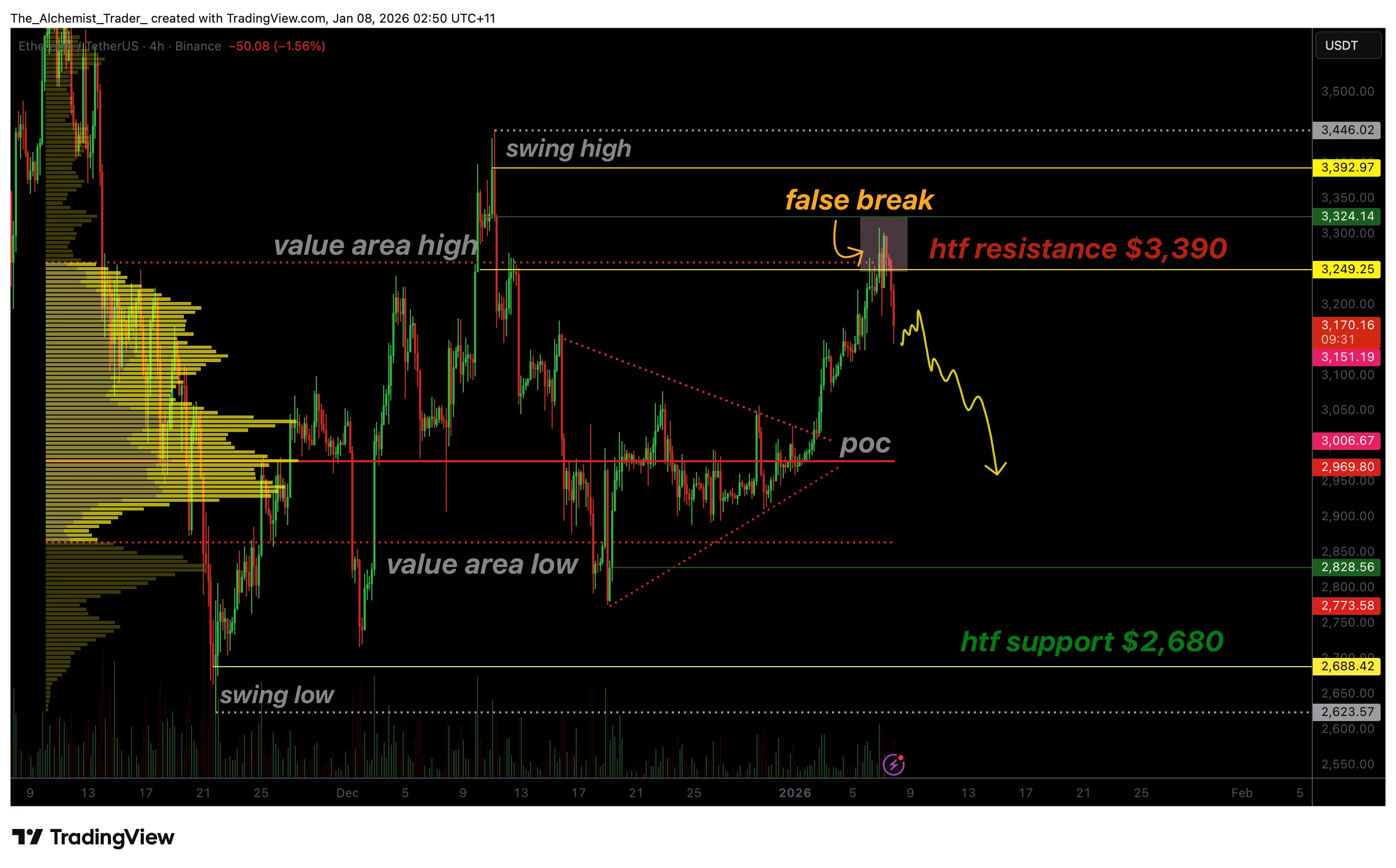
Ethereum’s attempted move above $3,300 lacked follow-through and was quickly met with aggressive selling. Importantly, price failed to hold above resistance on a closing basis, confirming that buyers were unable to establish acceptance at higher levels. This is a key characteristic of a failed auction, where price briefly trades above value only to be rejected back below it.
From a volume-profile perspective, the rejection is particularly significant. The Value Area High converges with the $3,300 resistance, creating a dense supply zone where sellers have consistently regained control. When price is rejected from such high-confluence regions, it often signals that the market has determined that higher prices are not currently sustainable.
The swift move back below the resistance suggests acceptance of the value rather than a simple liquidity sweep. In market auction theory, acceptance below resistance typically leads to continuation in the direction of the rejection, in this case, lower. This behavior increases the probability that the price will rotate toward the opposite side of the range to seek balance.
Market structure further supports this view. Ethereum continues to print lower highs, maintaining a corrective structure rather than transitioning into an impulsive uptrend. Each rally attempt has been met with selling pressure, indicating that bullish momentum remains weak and reactive rather than proactive.
The failed auction also highlights the presence of trapped long positions above $3,300. As price continues to trade below this level, these positions face increasing pressure, which can accelerate downside moves as stop-losses are triggered and positions are unwound. This dynamic often leads to sharper corrective phases than initially anticipated.
Why $2,680 Is Now in Focus
With resistance firmly holding, attention shifts to the next major high-time-frame support near $2,680. This level represents an important structural area in which prior demand emerged and where price may rebalance after the failed auction.
From a liquidity perspective, a move toward $2,680 would allow Ethereum to clear resting liquidity accumulated below the current price range. Markets often gravitate toward such areas following failed breakouts, as they represent zones of unfinished business.
A test of $2,680 would not necessarily signal a macro breakdown, but rather a continuation of Ethereum’s corrective phase within the broader range. However, failure to hold this support on a closing basis would significantly increase downside risk and open the door to deeper retracements.
What to expect in the coming price action
As long as Ethereum remains below the $3,300 resistance and the Value Area High, downside risk remains elevated. The confirmed failed auction increases the likelihood of a rotational move toward $2,680, where the price may attempt to stabilize.