
P2P cryptocurrency platforms are often described as marketplaces built on trust. However, as real-world experience shows, trust between users is the weakest component of security.
Modern P2P platforms remain secure not because users are honest, but because the system anticipates and takes into account the risk of their dishonesty.
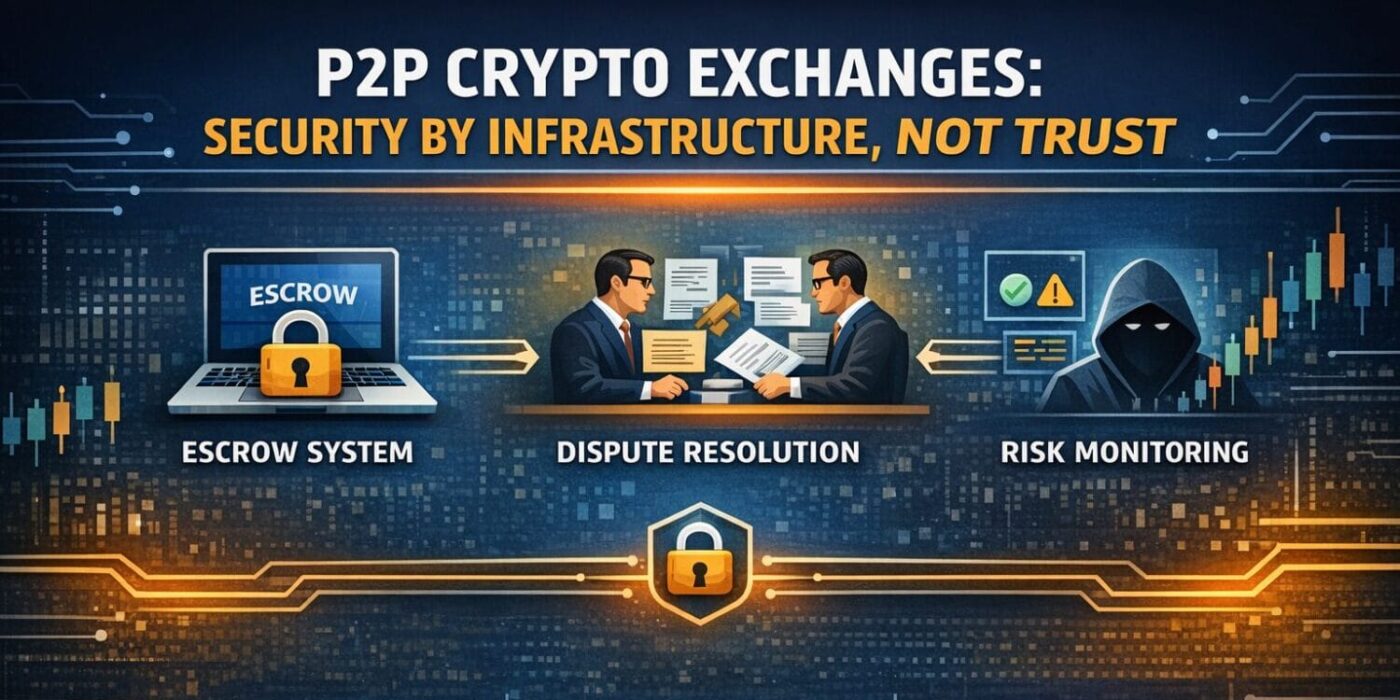
Behind every successful platform lies a robust P2P exchange infrastructure that functions as a multi-layered security ecosystem. This technical foundation integrates deterministic escrow mechanisms, evidence-based dispute resolution, and automated behavioral risk assessment. By hardcoding these compliance and verification logic layers into the system’s core, platforms can preemptively neutralize fraudulent attempts and ensure operational scalability without relying on manual oversight.
Today, it is this level of risk, not the goodwill of the crypto community, that determines whether a P2P platform will scale and operate effectively, or whether it will give up its position and fail.
Let’s look into the details of how this works in practice.

Escrow is a key base, not just a function
At the core of every P2P platform is escrow logic. This isn’t just a locking of funds, but a state machine that manages asset storage.
The production-level escrow system includes:
- Lock before the transaction. The cryptocurrency is locked before the buyer initiates the payment. No lock, no transaction.
- Conditional release rules. Funds are released only when payment verification is successful or the arbitration panel explicitly approves the release.
- Timeout mechanisms. If the buyer fails to make payment within the specified SLA window, escrow is automatically terminated and the funds are returned to the seller.
- Unilateral transitions. Escrow states cannot be manually cancelled by users. This can only be accomplished through system rules or arbitration.
By 2025, platforms with deterministic state machines for escrow are reporting a 30-45% reduction in dispute escalations, simply because extreme cases are resolved automatically before human intervention is required.
An escrow account isn’t just about preserving funds. It’s about eliminating ambiguity and ensuring strict adherence to the specifics of payment transactions.
Dispute Resolution Processes: Designing for Problems
Disputes in trading transactions are not the exception to the rule. On the contrary, they are expected systemic events.
A secure P2P platform should design dispute resolution as a primary workflow, not as a secondary support task.
Typical dispute resolution scenarios include the following situations:
- The buyer claims that the payment has been sent, the seller denies receiving it.
- The seller provides a fake “payment received” confirmation.
- The buyer uploads fake screenshots of bank statements.
- Payment sent from a third-party account.
- Attempts at social engineering (“pressure for urgent release”).
Modern dispute resolution centers implement the following mechanisms:
- Structured evidence collection. Screenshots alone are not enough. Metadata, timestamps, payment links, and account verification are essential.
- Logic that takes into account the payment method. Instant SEPA ≠ SWIFT ≠ local banking systems ≠ fintech wallets. Each has different settlement and return risks.
- Role-based arbitration. Arbitrators see system-level signals that users never see: risk assessments, previous behavior, device fingerprints.
- Decisions recorded in an audit log. Each arbitration decision is immutable and subject to review.
Platforms that implement formal dispute resolution workflows reduce false positives by approximately 40% and significantly limit internal abuse.
Payment verification: where fraud attempts most often fail
Over the past year, more than 60% of fraud attempts on P2P networks targeted payment confirmation logic rather than cryptocurrency storage. Why this priority? Because fiat payment systems are complex.
Key elements of verification control include:
- Checking for matching account names and ownership – payments from mismatched accounts trigger a check;
- Check links and amounts – partial payments, rounded values or reused links are cause for concern;
- Settlement delays – some payment systems “appear final” but remain reversible for several hours or days;
- Detection of third-party payments is a serious warning sign in P2P networks.
Trusted platforms don’t rely on user screenshots.
They rely on clear rules, received signals and allotted time.
Risk Level: Where is the Real Security?
Escrow alone isn’t enough. Beyond that lies a real layer of protection, including such important mechanisms.
1. KYC/AML as dynamic triggers
Modern platforms no longer treat KYC (know your customer) as a binary option. Instead, low-risk users trade with minimal barriers.
Risky behavior dynamically triggers:
- enhanced KYC mechanism;
- verification of the source of funds;
- temporary blocking of trading.
As of 2025, adaptive KYC has been able to reduce user churn by 20-25% while simultaneously improving fraud detection accuracy.
2. Behavioral signals and fraud risk assessment
Advanced P2P systems are capable of tracking:
- anomalies in the speed of transactions;
- recurring patterns of deal reversals;
- time until payment;
- reuse of devices and IP addresses;
- unusual language patterns in chats (social engineering markers).
All of these signals are used to generate real-time risk assessments that impact:
- time of release of funds from the escrow account;
- priority of disputes;
- trading limits.
3. Limits, reputation and progressive trust
Online reputation isn’t just about a pretty rating. Reliable P2P platforms use:
- reputation weighted by transaction volume;
- loss of reputation due to inactivity;
- penalties for disputed losses;
- limits for new or flagged accounts.
This way, new users can make trades but cannot cause systemic damage.
4. Blockchain compliance with security requirements and protection against “dirty” coins
The escrow service must be integrated with:
- verification in the blockchain;
- analysis for the presence of “dirty” assets;
- verification of compliance with sanctions requirements.
If an escrow service accepts “dirty” assets, the platform assumes a significant risk.
Regulators in many countries around the world are increasingly looking at P2P platforms as active intermediaries rather than neutral trading platforms.
5. Protection against chargebacks and social engineering
P2P platforms protect against:
- refund of payments in fiat currency after the release of cryptocurrency;
- false urgency (“release now or the account will be blocked”);
- impersonating customer support staff.
System delays, information banners, and required rules far outweigh user warnings.
How systems automatically handle “bad” cases
Well-designed P2P platforms react predictably to adverse scenarios, namely:
- Timeouts result in automatic return of funds to the deposit account.
- False confirmations as a consequence of disputes and risk reduction.
- Repeated abuse results in progressive restrictions.
- Losing in arbitration results in damage to reputation and limits.
It is this predictability that keeps liquidity providers and large-volume traders active.
Essential modules for production-grade P2P platforms
Building a production-ready system requires more than just a basic interface; it demands a sophisticated p2p exchange architecture that can handle deterministic finite state machines for escrow and irreversible transitions. By integrating these essential modules, platforms can ensure that every transaction is tracked and verified, preventing fraud at the infrastructure level.
The P2P platform is inherently vulnerable and therefore requires the implementation of effective working modules:
- Deposit mechanism. A deterministic finite state machine with irreversible transitions.
- Dispute Resolution Center. Evidence-based arbitration with audit trails.
- Risk monitoring and assessment. Behavioral signals, fraud protection logic, real-time triggers.
- Compliance level. KYC/AML, transaction verification, sanctions control.
- Audit and logs. Every action is tracked, verified, and ready for regulatory review.
Why Platform Reliability Is Determined by Infrastructure, Not Trust
Trust doesn’t scale. But platform infrastructure can. In the coming years, the most resilient P2P crypto platforms won’t be those with the friendliest communities. Those with strong advantages will be those with tedious, strict, predictable systems that quietly prevent negative consequences before users even notice.
The escrow logic, dispute resolution workflows, and risk management layers are not just additional security measures, but an effective foundation for the product itself.
Those P2P cryptocurrency platforms that understand this continue to operate during market cyclical changes.