

Editorial note: CoinCodeCap reviews are independent. We have no paid or affiliate relationship with Kulipa, and the external links here are standard links, not referral links. Everything below is based on Kulipa’s public product pages, API docs, partner case studies, and press coverage current as of June 2026. Always confirm current terms on Kulipa’s own site before building on it.
How We Reviewed Kulipa
We assessed Kulipa as B2B payment infrastructure, not as a consumer card. Our review draws on Kulipa’s own product and API documentation, the coverage of its $6.2 million seed round, partner integrations from Privy and Ready, and reporting from The Block, Finextra, and Flourish Ventures. We weighed five things: what the product actually does, how settlement works on-chain, the strength of its compliance and licensing model, real traction (cards issued, named customers, growth), and how it stacks up against rivals like Rain and Baanx. We earn nothing if you contact Kulipa.
TL;DR
- Kulipa is infrastructure that lets fintechs and crypto wallets issue their own stablecoin-backed Visa and Mastercard cards through one API.
- You can’t get a “Kulipa card” as an individual. You get a card from one of its clients, such as Solflare or Ready.
- Spending settles against USDC on-chain. Kulipa handles the fiat conversion plus KYC, KYB, and AML.
- It runs a local-first licensing model, live in the EU, Argentina, and Nigeria, with the US in progress.
- It has issued 120,000+ cards since February 2025, signed about 20 customers, and raised $6.2M led by Flourish Ventures and 1kx.
- Our take: about 4.3/5 for fintech builders in its supported markets. Strong wedge, young company.
Kulipa at a Glance
What Is Kulipa, Exactly?
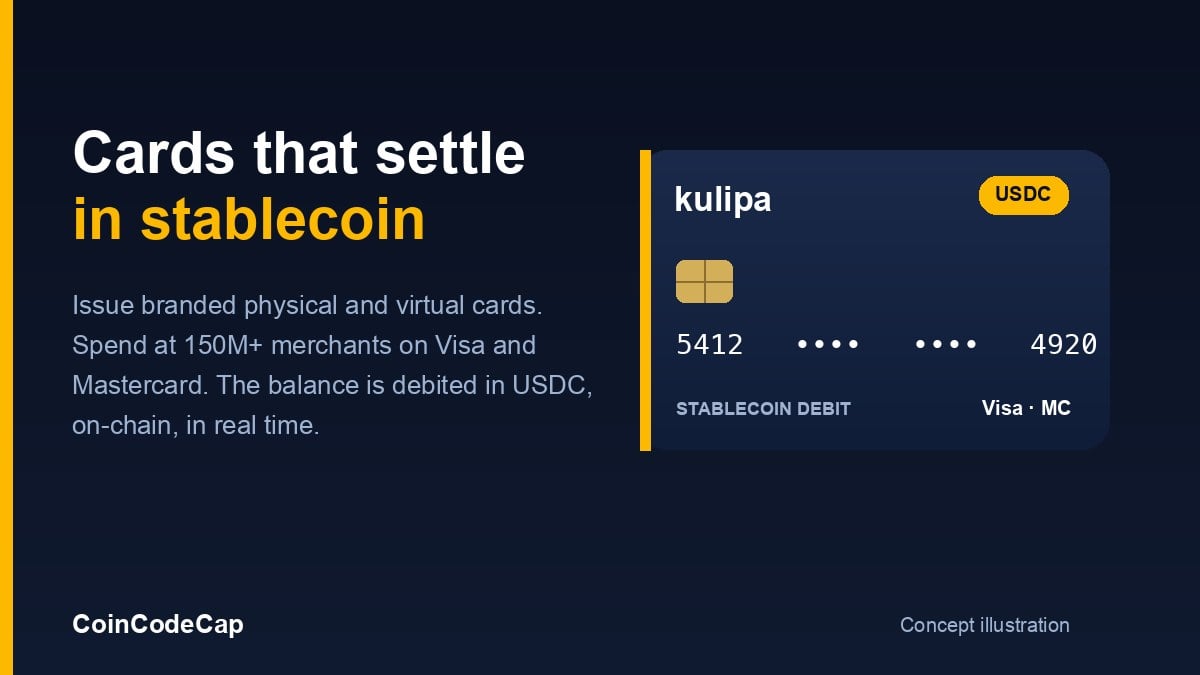
Kulipa is payment infrastructure, not a card you order for yourself. The company builds the plumbing that lets fintechs, neobanks, and crypto wallets launch their own stablecoin-backed cards and accounts under their own brand. Kulipa calls itself “the stablecoin engine for modern fintechs,” and the label fits. Your customers never see Kulipa. They see the card your app issued.
The gap it fills is real. People hold a lot of value in stablecoins like USDC, but actually spending those digital dollars at a corner shop is still clumsy. Most wallets and apps don’t hold the licences, the compliance stack, or the Visa and Mastercard relationships you need to connect an on-chain balance to a card terminal. Kulipa bundles all of that behind one API, so a team can ship a compliant card program in a few weeks instead of spending a year chasing scheme membership country by country.
A quick reality check before we go further. If you’re an individual who just wants a crypto card today, Kulipa isn’t where you sign up. You’d use one of its clients, such as Solflare or Ready. This review is mostly for the people deciding whether to build on Kulipa, plus anyone curious about what’s running behind a card their wallet just offered them.

How Kulipa Works
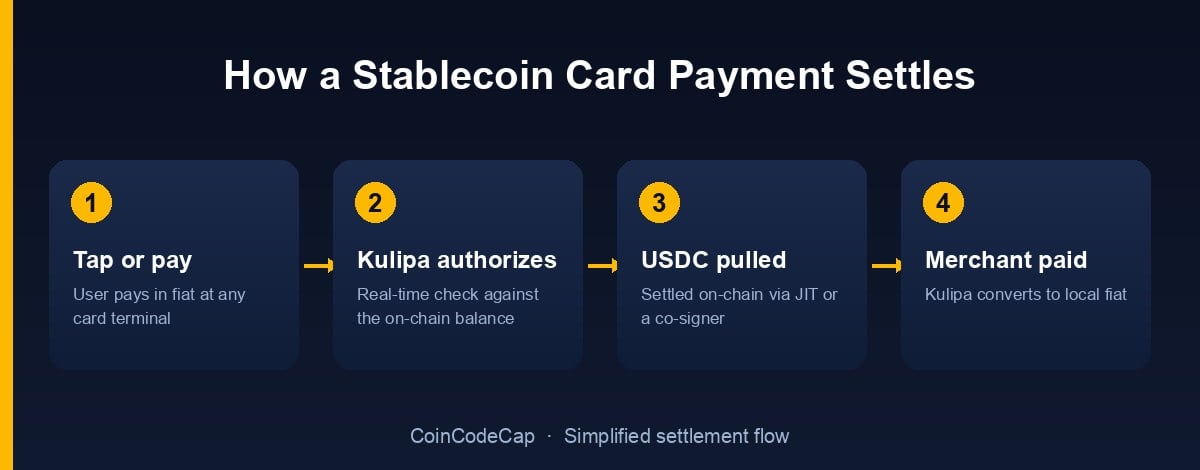
Here’s the part that matters if you’re a builder. Kulipa offers three ways to settle a card payment against an on-chain stablecoin balance, and they aren’t interchangeable.
- Just-in-time (JIT) approval. When a card authorization comes in, Kulipa requests the funds from the user’s wallet right then and settles on-chain inside the authorization window. This works with any wallet, but it leans on fast blockchains. Kulipa points to networks with sub-second blocks, like Avalanche, because the whole transfer has to clear before the terminal times out.
- Cooperative approval. Here Kulipa acts as a limited co-signer inside the user’s self-custodial wallet. It gets narrow permission to pull the settlement token (USDC, say) when a purchase happens, and nothing else. The user invites Kulipa in, and the user can remove it later, usually after a short time delay. It’s a clever way to keep self-custody while still guaranteeing the merchant gets paid.
- Prefunded. The simplest option. The user tops up a separate wallet, and spending draws down from there. It’s the easiest to integrate and the easiest to reason about, at the cost of the pure self-custody story.
Underneath, the idea is the same each time. The user spends in fiat at the terminal, Kulipa handles the conversion to local currency, and the user’s stablecoin balance gets debited. Kulipa also runs KYC, KYB, and AML monitoring, so you’re not stitching together a separate compliance vendor on top.
I like that Kulipa is upfront about the trade-offs. JIT needs a quick chain. The cooperative model changes your wallet’s security assumptions because you’re granting a co-signer. Prefunded softens the non-custodial pitch. None of these is wrong, but they’re real choices, and you should pick deliberately.
What You Can Build With Kulipa

Kulipa splits its product into three pieces. Cards are the headline. You can issue physical and virtual cards on Visa or Mastercard, add Apple Pay and Google Pay, brand them as your own, and freeze a compromised card instantly. They’re true debit cards that settle in stablecoin, and Kulipa handles production, packaging, and shipping for the physical ones. Both consumer and business cards are supported, so a payroll or expense product is on the table, not just personal spending.
Wallets let you launch bank-account-style balances inside your app, with the wallet infrastructure embedded. Virtual Accounts give you white-labelled account details so users can receive normal bank transfers that land as stablecoin, which is the on-ramp side of the same loop.
Put together, you get something close to a neobank stack: fund in by bank transfer, hold as stablecoin, spend on a card. For a crypto wallet that wants to become, in the words of Ready’s CEO, “an on-chain alternative to banks,” that’s the whole pitch.
Supported Stablecoins, Chains, and Networks
Kulipa is chain-agnostic by design. Its docs say it can deploy on “any blockchain, from EVM chains to L2 or Solana, and many more.” In practice the settlement asset today is mostly USDC and its wrapped versions, with Paxos-issued stablecoins also supported. That’s narrower than the “any stablecoin” impression the marketing can give, so confirm your specific token is covered before you commit.
On the card side, Visa and Mastercard between them reach more than 150 million merchants, which is the entire point. Your users spend anywhere cards are accepted, and the crypto part stays invisible. Card acceptance spans 100+ countries. Issuing is a different question, and that’s next.
Compliance and the Local-First Model
This is where Kulipa is more interesting than the average crypto-card API, and it’s worth slowing down on. Instead of issuing from one jurisdiction and hoping it travels, Kulipa runs what it calls a local-first model. It gets regulated coverage market by market and tailors the product to each one. CEO Axel Cateland put it plainly: “We’ve focused on being as local as possible by understanding regulations.”
Right now that coverage is live across the European Union, Argentina, and Nigeria, with the United States in progress. Those three markets say a lot about the strategy. The EU is the regulated core, Argentina is a heavy stablecoin-adoption market, and Nigeria is one of the most active crypto economies in Africa. Kulipa has on-the-ground teams in Buenos Aires and Lagos, not just a head office in Paris and London.
The flip side: local-first means coverage is uneven. If your users sit in a market Kulipa hasn’t licensed yet, you wait. For a US fintech, that wait is the deciding factor today.
Traction: Is Anyone Actually Using It?
Yes, and this is the strongest part of the story. Kulipa only opened its infrastructure in February 2025, and within months it had issued more than 120,000 cards and signed around 20 customers. Transaction volume was growing roughly 70% month over month off that base.
The customer names aren’t filler, either. Flutterwave is one of Africa’s biggest payment companies. nSave handles cross-border savings. Solflare is a major Solana wallet, and Ready (the wallet formerly known as Argent) is a recognized name in smart-wallet circles. Privy, the wallet-infrastructure provider, has a published integration showing how Kulipa cards plug into Privy-powered self-custodial wallets. For a company this young, that’s a credible roster.
I’d still treat the numbers as early. 120,000 cards issued is not 120,000 cards in heavy weekly use, and a year of operating history is short for payments, where the hard problems (fraud, chargebacks, edge-case compliance) tend to surface at scale. Promising, not yet proven.
Funding and Investors
Kulipa raised a $6.2 million seed round in 2025, co-led by Flourish Ventures and 1kx, with White Star Capital and Fabric Ventures joining. That followed a $3 million pre-seed in July 2024, putting publicly reported funding around $9.2 million. (Kulipa’s own about page cites roughly €10.5 million raised to date, so the cumulative figure depends on how you count.)
The investor mix is telling. Flourish Ventures is a fintech fund built around financial-inclusion bets, and 1kx is a serious crypto-native investor. Flourish’s reasoning for the deal was blunt: stablecoins move trillions a month on-chain, but almost none of that can be spent at a normal merchant, and someone has to build the layer that fixes it. They think Kulipa is that layer.
The Team Behind Kulipa
The founding team is the kind you’d want for this problem. CEO Axel Cateland came out of Mastercard’s digital payments side and was a banking lead at the French unicorn Spendesk. CTO Michael Shynar spent eight years as a staff engineer at Google and helped build WhatsApp’s commerce platform at Meta. Benoit Roger, the head of compliance, has worked at Nickel, Lemonway, and Binance France, a useful mix of mainstream fintech and crypto regulation. Diego Sánchez, the LATAM GM, is ex-Bitso.
Payments plus crypto plus regulation is exactly the blend this product needs, and the team has all three. The company is 20-plus people spread across Paris, London, New York, Buenos Aires, and Lagos.
Kulipa vs the Competition
Kulipa isn’t alone. Stablecoin card infrastructure got crowded and well-funded through 2025. Here’s how the main players line up.
The short version: Rain and Reap are full-stack issuers and Visa Principal Members, which lets them issue directly on Visa without a sponsor, and they tend to chase enterprise deals. Baanx is the closest match to Kulipa’s white-label, self-custodial angle, and it got bought for around $175 million in November 2025, which tells you how much this category is worth. Kulipa’s edge is the local-first licensing in emerging markets and a truly self-custodial settlement model, rather than trying to be the biggest single-network issuer.
Pros and Cons
Pros
- One API replaces licensing, processing, and card-scheme relationships
- Truly self-custodial card model, with user-controlled revocation
- Local-first licensing already live in the EU, Argentina, and Nigeria
- Real traction: 120,000+ cards and named partners like Flutterwave and Ready
- Backed by credible fintech and crypto investors (Flourish, 1kx)
- Chain-agnostic, including Solana and EVM/L2 support
Cons
- Not a consumer product; you can’t sign up as an individual
- Young company with a short public track record (infra live since Feb 2025)
- Pricing isn’t public; you have to talk to sales
- US issuing isn’t live yet
- Stablecoin support is narrow today (mainly USDC plus Paxos)
- Crowded, well-funded rivals (Rain, Baanx, Reap)
Expert tip: When you demo Kulipa, ask exactly which settlement model applies on the chain you plan to use. JIT needs a sub-second network, and the cooperative co-signer model changes your wallet’s security assumptions because you’re granting a third party limited signing power. Then confirm which licence covers each target market, since local-first coverage varies country by country. Those two answers decide most of your integration risk.
Who Should Use Kulipa (and Who Shouldn’t)
Build on Kulipa if you’re a wallet, neobank, payroll, or remittance product that wants to ship a branded card without becoming a licensed issuer yourself, especially if your users are in Europe, Argentina, or Nigeria. The self-custody model is a real selling point if your audience cares about holding their own keys.
Look elsewhere, for now, if you need US issuing today, if you want broad multi-stablecoin support beyond USDC, or if you just want a crypto card for personal use (go to one of Kulipa’s partner apps instead). And if you’re an enterprise that needs a Visa Principal Member with years of scale behind it, Rain or Reap may suit you better. If you’re still mapping the space, our guide to the best crypto exchanges and the top trading platforms on Solana covers where most users buy the stablecoins these cards spend.
7 Frequently Asked Questions About Kulipa
What is Kulipa and what does it do?
Kulipa is B2B infrastructure for stablecoin payments. It lets fintechs and crypto wallets issue their own branded cards, virtual accounts, and wallet balances through a single API, with the on-chain settlement, fiat conversion, and compliance handled for them.
Can I get a Kulipa card as an individual?
No. Kulipa sells to companies, not consumers. To use a card powered by Kulipa, you sign up with one of its clients, such as the Solflare or Ready wallet.
Which stablecoins and blockchains does Kulipa support?
Settlement today centers on USDC and its wrapped versions, plus Paxos-issued stablecoins. Kulipa is chain-agnostic and can deploy on EVM chains, layer 2s, and Solana, among others.
Is Kulipa self-custodial or does it hold my funds?
It depends on the model. In the cooperative setup, Kulipa is a limited co-signer in the user’s self-custodial wallet, and the user can remove it. There’s also a prefunded option where funds sit in a separate wallet, which is simpler but less self-custodial.
Where is Kulipa available?
Card issuing is live in the European Union, Argentina, and Nigeria, with the United States in progress. Card acceptance, through Visa and Mastercard, reaches more than 150 million merchants across 100-plus countries.
Who are Kulipa’s main competitors?
The closest rivals are Rain, Reap, and Baanx. Rain and Reap are full-stack Visa Principal Members aimed at enterprises, while Baanx is the nearest match to Kulipa’s white-label, self-custodial approach and was acquired for around $175 million in late 2025.
How much does Kulipa cost?
Kulipa doesn’t publish pricing. It markets itself as roughly 10x more cost-efficient than legacy issuing and advertises zero collateral or prefunding requirements, but you’ll need to contact its sales team for actual numbers.
Bottom Line
Kulipa is one of the more credible bets in stablecoin card infrastructure. The team has the right background, the local-first licensing is a smart wedge into markets where stablecoins already matter, and the self-custodial settlement model is genuinely differentiated. The early traction and investor backing are real.
It’s also young, the pricing hides behind a sales call, US coverage isn’t live yet, and the competition is fierce and better capitalized in places. For a builder in Europe, LATAM, or Africa weighing how to launch a card, Kulipa belongs on the shortlist and deserves a demo. Our take: about 4.3 out of 5 for fintech builders in its supported markets. Just remember it’s infrastructure, not a card you can swipe yourself.
Editorial note: This review was researched and written by the CoinCodeCap team in June 2026, drawing on Kulipa’s product and API documentation, its $6.2M seed-round coverage from The Block and Finextra, Flourish Ventures’ investment write-up, and partner integrations from Privy and Ready. We don’t have a commercial relationship with Kulipa. Figures and coverage can change, so verify the latest details on Kulipa’s own site.