
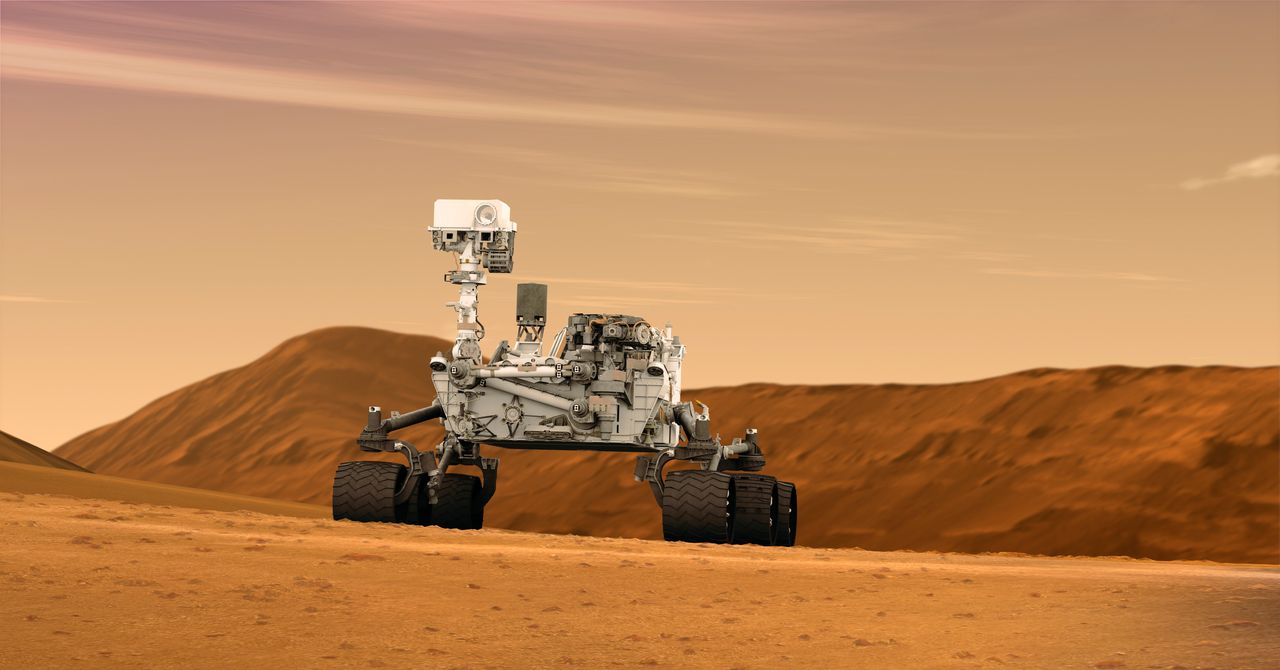
While it has enabled many exciting discoveries, the Curiosity Rover has also encountered its share of setbacks. The latest left NASA engineers speechless.
On April 25, Curiosity drilled into a rock nicknamed “Atacama” to collect a sample. When the rover retracted the robotic arm after drilling, the entire rock unexpectedly lifted off the Martian surface—all 28.6 pounds of it. While other Curiosity drilling operations have caused cracks or breaks in the upper layers of Martian rocks during the rover’s nearly 14-year mission, this is the first time one has remained stuck to the sleeve that surrounds the drill’s rotating tip.
As the space agency itself recounts, it was the black-and-white obstacle-detection cameras mounted on the front of the rover’s chassis that captured this peculiar “accident” in a sequence of images that allowed engineers to get to work immediately to free it, moving its robotic arm and operating the drill repeatedly over several days.
Engineers initially tried to remove the rock by vibrating the drill, to no avail. On April 29, they adjusted the position of the robotic arm and tried vibration again, but only managed to knock some sand off the rock. On May 1, the team gave it another try by tilting the drill more, rotating and vibrating it, and spinning the drill bit. The team expected to have to repeat these operations several times, but instead the rock broke loose on the first attempt, shattering into a multitude of pieces when it hit the Martian soil.
NASA’s Curiosity rover was developed by the Jet Propulsion Laboratory and landed on Mars in August 2012 with the purpose of looking for evidence that the Red Planet might have once had conditions that could support microbial life. In 2020, it conducted an experiment in the Glen Torridon region within Gale Crater, an area rich in clay minerals that strongly indicate the presence of water in the past and that it collected using onboard instruments known as Sample Analysis on Mars.
This story originally appeared in WIRED Italia and has been translated from Italian.