
Key Takeaways
- Ripple expanded RLUSD’s reach through Wormhole’s Native Token Transfers across supported blockchain ecosystems.
- Institutional users gain stronger access to compliant dollar liquidity for payments, tokenization, and ramps.
- Further network growth could boost RLUSD’s role in cross-chain stablecoin infrastructure.
Ripple’s Stablecoin Expansion Pushes RLUSD Across Multiple Blockchain Ecosystems
Ripple shared on X on June 4 that its U.S. dollar-backed stablecoin Ripple USD (RLUSD) can now move natively across blockchain ecosystems through Wormhole’s Native Token Transfers (NTT). The update strengthens RLUSD’s role in cross-border payments, institutional on- and off-ramps, and tokenization. It also gives developers and institutions broader access to compliant dollar liquidity.
The announcement broadens RLUSD’s role within blockchain-based finance. Ripple said the stablecoin can move natively through Wormhole’s NTT framework, creating additional pathways for payment flows, tokenization initiatives, and institutional liquidity management. The expansion could increase RLUSD’s usefulness for organizations operating across multiple blockchain ecosystems.
Ripple stated:
“Through Wormhole’s Native Token Transfers (NTT), RLUSD can now move natively across multiple blockchain ecosystems, supporting cross-border payments, institutional on/off-ramps, and tokenization use cases.”
“For developers and institutions building onchain, that expands access to compliant, USD-backed liquidity across supported networks,” the firm added.
Wormhole’s Native Token Transfers is a framework for moving native tokens across different blockchains. Wormhole says NTT allows issuers to maintain control of their tokens across networks while preserving native functionality, including metadata, ownership, upgradeability, and custom features. It also supports rate limits, access controls, and supply accounting, giving issuers greater oversight of cross-chain token movement.
Wormhole’s Multichain Standard Could Widen RLUSD’s Developer and Institutional Use
Ripple’s multichain strategy has developed in stages. After its native launch on the XRP Ledger (XRPL) and Ethereum, RLUSD moved into Layer-2 expansion through Wormhole’s NTT standard. Ripple later identified Optimism, Base, Ink, Unichain, and the XRPL EVM Sidechain as target ecosystems, while Wormhole said the model helps preserve issuer control and native token functionality across networks.
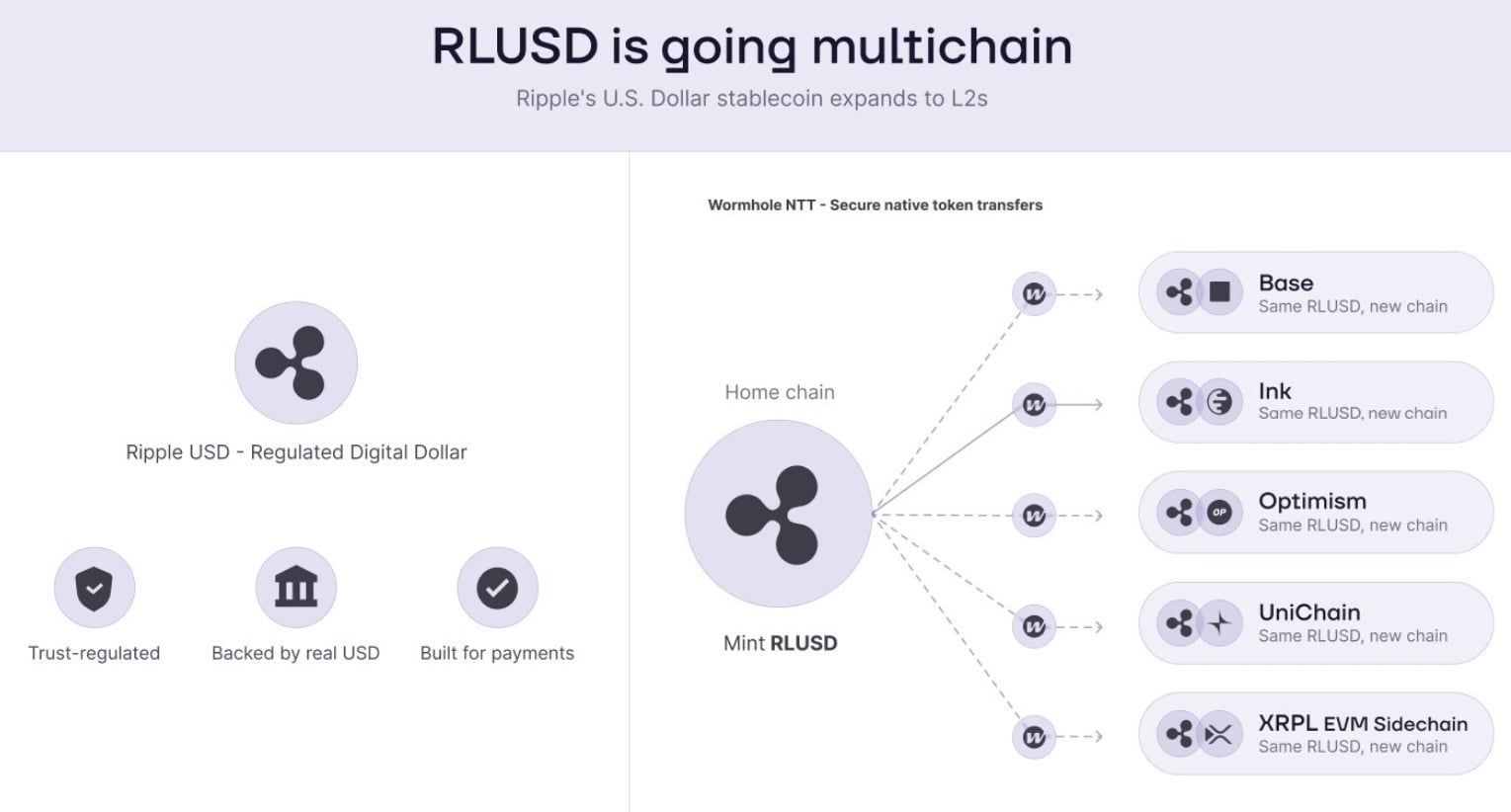
Bridge infrastructure has also added new routes for RLUSD movement. Wanchain integrated the stablecoin into its bridge architecture, enabling transfers across XRPL, Ethereum, Cardano, and Wanchain. The added connectivity provides another channel for RLUSD liquidity as Ripple expands institutional access across multiple blockchain ecosystems.
“Institutional-grade stablecoins just went multichain,” Wormhole stated on X, adding:
“Ripple’s RLUSD is now live across ecosystems via Wormhole’s Native Token Transfers (NTT) — the standard trusted by 100+ assets across 40+ chains. Compliant. Native. Multichain.”
RLUSD has grown rapidly since its launch. The asset had $1.731 billion in circulation as of May 28, backed by $1.833 billion in reserve funds, according to Ripple’s transparency report. The latest Wormhole integration builds on earlier expansion efforts by extending RLUSD’s reach across additional blockchain ecosystems and supporting its role in payments, tokenization, and institutional liquidity.