

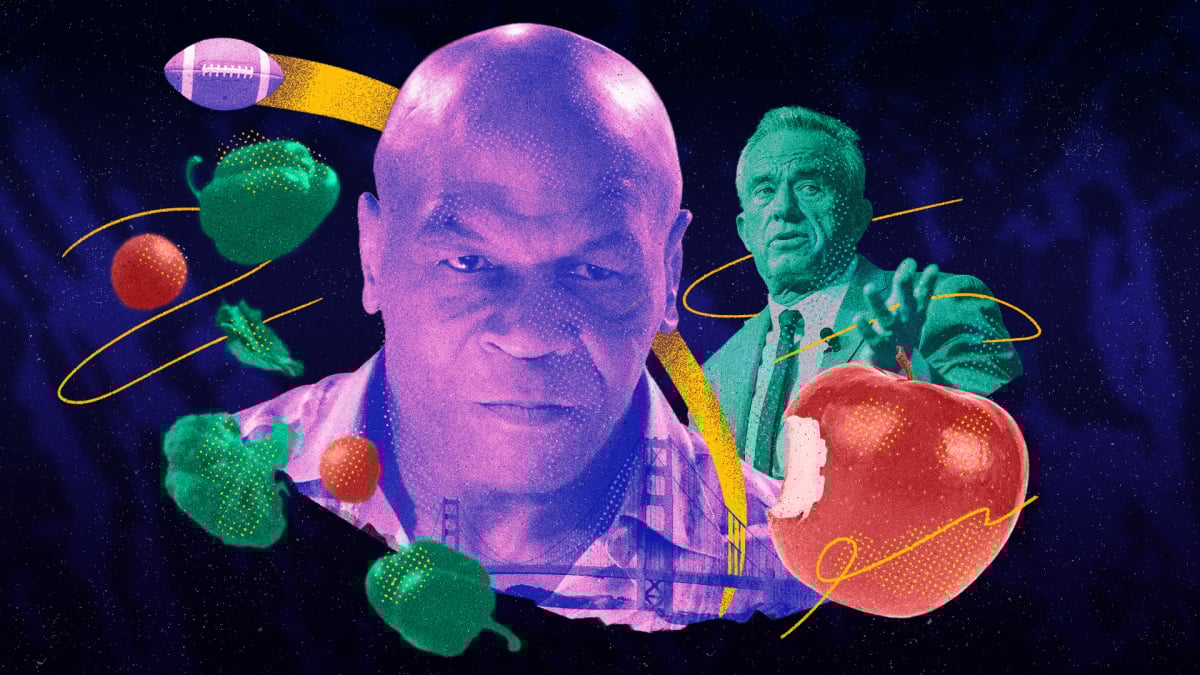
Lessons learned from the 2026 Super Bowl ad lineup: Online gambling is super cool, just ask Kendall Jenner, and Coinbase is actually fun — are you sure you didn’t like the Rickroll-esque karaoke spot? Beloved ’90s celebs, de-aged to look like 20-somethings again, just absolutely love Dunkin’ Donuts coffee, so you should drink it, too. Oh, also, being fat makes you want to kill yourself.
It was a stark black-and-white ad, dramatically framed to center the tattooed face of former boxing titan Mike Tyson. Tyson kicks off the ad by telling us that his sister Denise “died of obesity” at just 25 years old. It was a heart attack, he adds. Dramatic cut to his clasped hands. “I was so fat and nasty,” Tyson tells the camera, his sister’s story just teeing up his own message. “I would eat anything. I was like 345 pounds.” The music swells. “I had so much self-hate when I was like that. I just wanted to kill myself.” He bites into a carrot, then an apple. He tells Americans, likely half-listening as they enjoy some decadent dips and spicy wings with their loved ones, that we are still a bunch of obese, “fudgy” people despite being the most powerful country in the world.
Did you know powerful people are all fit and skinny, and that our physical appearance makes our country’s actions morally defensible? Wait, is that not the point? What is the point? “Process food kills,” the screen reads. Oh.
We, viewers already inundated with incessant ads for GLP-1 medications peddled by former body positivity icons like Serena Williams, take a bite of our burgers and a sip of our beers, which are also being sold to us ad nauseam during the live broadcast. This PSA makes those other ads look exceedingly compassionate.
The ad was helmed by Brett Ratner — the Hollywood creative recently under fire for directing Melania Trump’s Amazon-funded documentary, as well as his connection to the Epstein files — and appears to ignore the fact that the former heavyweight is a convicted rapist and abuser. It was funded by the Make American Healthy Again initiative, the brainchild of Robert F. Kennedy Jr., U.S. Secretary of Health and Human Services (HHS). Kennedy is a man known for having found a worm in his brain and spewing dumbfounding medical claims, including the notion that Tylenol “causes” autism and that COVID-19 was a bioweapon designed to target specific races.
It is not new for fat people to collectively be attacked by the U.S. government.
The administration has its own ties to billionaire techies, many of whom have invested heavily in the wellness space and influencers who peddle alternative science and fad diets. MAHA Center chief Tony Lyons said they solicited an undisclosed amount of billionaires to fund the PSA. If you go to the official RealFood.gov website — linked at the end of the PSA and now rebranded with scary black and white text and the image of Tyson — you’ll encounter an AI chatbot not too far down. It’s designed to help Americans learn about “real food.”
MAHA claims it is tackling the “childhood chronic disease crisis” and nationwide health concerns with what medical experts have noted is unfounded, conspiracy-based “science.” Under Kennedy, MAHA’s strategy has been to eschew decades of medical research, diminish vaccine infrastructure, reduce the country’s health agencies, and even redesign the standard food pyramid. It has also decided that fat people are a national scourge.


Credit: Mashable screenshot / HHS / realfood.gov
It has chosen to invest instead in the ideals of the manosphere, promoting hypermasculine, fitness-based solutions to mental and physical health. It’s thus notable that MAHA would choose the boxer, of all people, to be the face of the “real foods” movement, says Jessica Wilson, clinical dietician, MAHA critic, and host of the Making It Awkward podcast. Wilson points to statements by both Kennedy and Secretary of War Pete Hegseth, equating fatness with a lack of military preparedness.
Mashable Trend Report
Online, the MAHA crowd rallied for the spot, writing that it was “declaring WAR on obesity.” But professionals know this is not the way to promote healthy eating, if that’s even what MAHA’s goals were.
“A Department of Health & Human Services–sponsored Super Bowl ad used unframed suicide ideation, weight-shaming language, and moralized food rhetoric, then HHS Secretary RFK Jr’s official government X account amplified it with an AI-generated image and a vague slogan,” wrote Dr. Zachary Rubin, an allergist and online creator known for debunking viral medical myths and advice. “This isn’t just ‘edgy’ messaging. It’s a failure of public-health ethics.”
This Tweet is currently unavailable. It might be loading or has been removed.
Tyson is well known for his unconventional diet, but one that involves the appendages of his sparring opponents, not “a pint of ice cream every hour” as the ad implies. Users were confused why the athlete was the face of the PSA — when was Tyson ever known for being quintessentially overweight? And what is he actually asking us all to do? There is no call to action, no acknowledgement of the corporate interests that have siloed access to processed rather than whole foods. It doesn’t highlight federal food programs or address the health and economic disparities that lead to widespread nutrition gaps for Americans. It also ignores that weight is not the sole determinant of health, and reinforces the idea that fatness is inherently deadly. It is not.
“Nothing about that advertisement was about making people healthier. It was about conforming to a certain body type,” says Tigress Osborn, executive director of the National Association to Advance Fat Acceptance (NAAFA). “People deserve meaningful healthcare in whatever body they are in — mental and physical healthcare. Instead, this is utilizing anti-fatness to fan the flames of emotion.”
In effect, a hate message for fat people that cost millions.
“The requirement of conformity to a particular aesthetic and a particular acceptable body type goes along with fascism and nationalism,” says Osborn. “We see those tactics employed across the government and public policy. It is not new for fat people to collectively be attacked by the U.S. government.”
This Tweet is currently unavailable. It might be loading or has been removed.
Treating people with larger bodies as a monolith, rather than individuals with individual health journeys, the ad takes advantage of a precarious online media moment, one in which users are facing a barrage of fatphobic content and pro-weight loss advertising that is using celebrities to sell products.
“If they cared about the health of Americans,” says Wilson, “they wouldn’t put a sex offender as the face of their Super Bowl ad and their official website. It is absolutely inconsistent with wanting to increase or improve the health of Americans and children. As clinical dietitians and health professionals know, trauma, including sexual violence, will lead to unhealthier kids.”
The message of the Mike Tyson PSA lays it all out on the table, served up next to the processed foods we’re pushed to eat on Super Bowl Sunday: You must be skinny, and if you’re not, shame on you.
If you feel like you’d like to talk to someone about your eating behavior, text “NEDA” to the Crisis Text Line at 741-741 to be connected with a trained volunteer or visit the National Eating Disorder Association website for more information.
If you’re feeling suicidal or experiencing a mental health crisis, please talk to somebody. You can call or text the 988 Suicide & Crisis Lifeline at 988, or chat at988lifeline.org. You can reach the Trans Lifeline by calling 877-565-8860 or the Trevor Project at 866-488-7386. Text “START” to Crisis Text Line at 741-741. Contact the NAMI HelpLine at 1-800-950-NAMI, Monday through Friday from 10:00 a.m. – 10:00 p.m. ET, or email [email protected]. If you don’t like the phone, consider using the 988 Suicide and Crisis Lifeline Chat. Here is a list of international resources.